
Who were the athletes?
An athlete was an ἀθλητής. The word belongs to one family with ἆθλος, a contest, and ἆθλον, a prize. So an athlete was a person who competed for a prize. Today a Greek sports star is still an αθλητής.
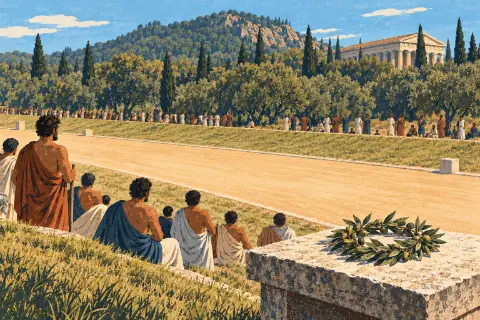
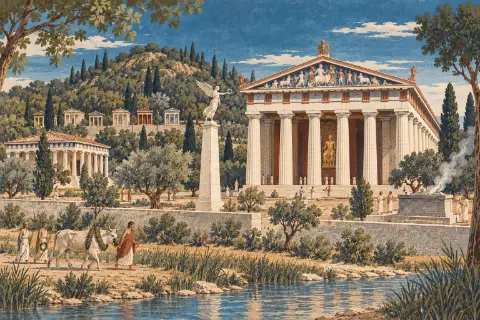
At the Olympic Games, only free Greek men and boys could compete, and their parents had to be free too. Boys had their own contests. Women could not compete there, but girls ran their own races at Olympia, the Heraia. The writer Pausanias tells a story about one brave mother. She dressed as a trainer to take her son to the Games.
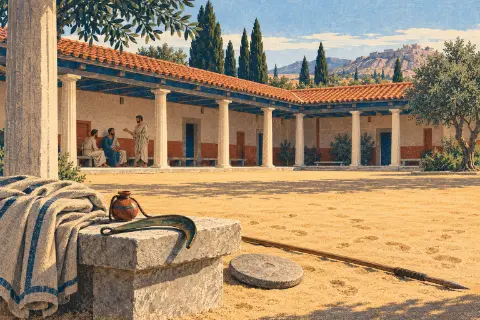
Athletes trained in the palaestra and the gymnasium. Runners and wrestlers competed naked, with oil on their skin. They carried the oil in a small round pot, the aryballos. Many sports grew out of hunting and war. The javelin, for example, began as a weapon.
Test yourself: 4 words from this page
1 / 4
What does this word mean?
Run, jump, throw, fight
At Olympia there was only one winner in each event, so there was no silver medal. These were the main sports:
- Running. The shortest race, the στάδιον, was about 192 metres at Olympia. The same word also named the track, and the modern word στάδιο comes from it.
- Discus. The δίσκος was first made of stone and later usually of bronze. Some were light, for boys, and some were heavy, for men. Around 450 BC the sculptor Myron made a famous bronze discus thrower. It is lost, but Roman marble copies survive.
- Javelin. The ἀκόντιον was a wooden pole about as tall as the athlete, thrown with a leather loop.
- Jump. For the ἅλμα, athletes held weights, the ἁλτῆρες, of about 1.5 to 4 kilos, and swung them to jump further. Today αλτήρες are dumbbells: the word came back into Greek through French.
- Fighting sports. These were wrestling, πάλη, boxing, πυγμαχία, with leather straps around the hands, and the rough παγκράτιον, a mix of both.
The πένταθλον had five events: running, jump, javelin, discus and wrestling. Experts are still not sure if the jump was one leap or several.
Leaves, oil and fame
At the four greatest festivals, the prize was a crown of leaves: wild olive at Olympia, laurel at Delphi, pine at Isthmia and wild celery at Nemea. Today a prize in Greek is an έπαθλο, from the ancient ἔπαθλον.
Other games gave valuable prizes. At the Panathenaic Games in Athens, winners received big painted jars of olive oil. These jars carry the words ΤΟΝ ΑΘΕΝΕΘΕΝ ΑΘΛΟΝ, “from the games at Athens”. A winner’s city could reward him too. Plutarch says that a law of Solon gave 500 drachmas to an Athenian who won at Olympia.
Some athletes became stars. Milo of Croton won the wrestling at Olympia six times, the first time as a boy. Pausanias says that nobody could pull a pomegranate from his hand, yet he did not crush it. Leonidas of Rhodes won the same three running races at four Games in a row, from 164 to 152 BC: twelve crowns! Tradition says that the boxer Diagoras of Rhodes was carried on the shoulders of his two winning sons. Kyniska of Sparta, a king’s daughter, was the first woman to win the crown, because she owned the winning horses.
A marble stadium in the middle of Athens
Athens had its own stadium for the sports of the Great Panathenaia. The politician Lycurgus built it around 330 BC, in a hollow between two hills. At first its sides were only earth. Around 140 AD, the rich Herodes Atticus paid to cover it with white marble. The traveller Pausanias called it a marvel to see: στάδιόν ἐστι λευκοῦ λίθου, “a stadium of white stone”.
Later the stadium was abandoned, and people took its marble for other uses. For the 1896 Olympic Games, it was rebuilt with money given mainly by George Averoff. Time was short. According to the Foundation of the Hellenic World, only the first four rows were marble in 1896, and the upper rows were wood painted white. The marble work was finished a few years later. In 1896 the runner Spyros Louis won the marathon and finished here.
The stadium is still in use. In July 2026 it held a pole vault meeting, and in Greek pole vault is άλμα επί κοντώ, with the ancient word for a jump. That same year, workers began the first systematic cleaning of its marble in 120 years.
Key dates
- 708 BCThe pentathlon and wrestling join the Olympic Games.
- 540 BCMilo of Croton wins the boys’ wrestling at Olympia.
- 464 BCDiagoras of Rhodes wins the boxing at Olympia.
- c. 450 BCMyron makes his bronze discus thrower.
- c. 396 BCKyniska’s horses win at Olympia, and the crown is hers.
- c. 330 BCLycurgus builds the Panathenaic Stadium in Athens.
- 164–152 BCLeonidas of Rhodes wins twelve Olympic crowns.
- 1896The first modern Olympic Games open in the rebuilt stadium.
Eight words, then and now
| Ancient Greek | Greek today | Meaning |
|---|---|---|
| athlete | ||
| great feat (once: contest) | ||
| prize | ||
| stadium | ||
| discus; also a music record | ||
| jump | ||
| dumbbells (once: jumping weights) | ||
| boxing |
 The ancient Olympic Games
 The gymnasium and palaestra in ancient Greece
 Olympia: the sanctuary of Zeus