
What was music for the Greeks?
The word μουσική (mousike) comes from the Μοῦσαι, the Muses, goddesses of song and poetry. At first it meant any art of the Muses, especially poetry that was sung. So a poem was often a song, and a song could go with dancing.
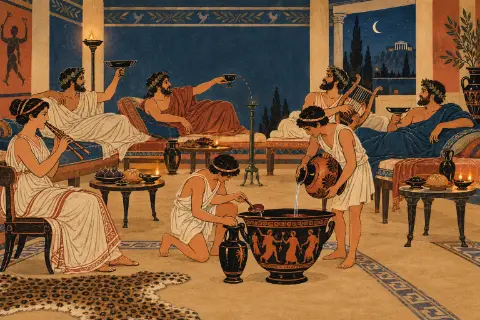
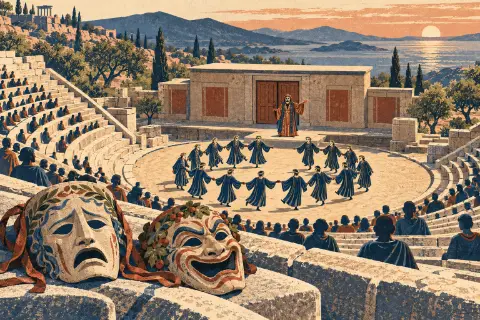
Music was part of many events: festivals and sacrifices to the gods, weddings, drinking parties and the theatre. It was even used in war. The historian Thucydides (5.70) says that Spartan soldiers walked slowly into battle with many aulos players among them. This was not for religion, he explains. It helped them keep in step and stay in line.
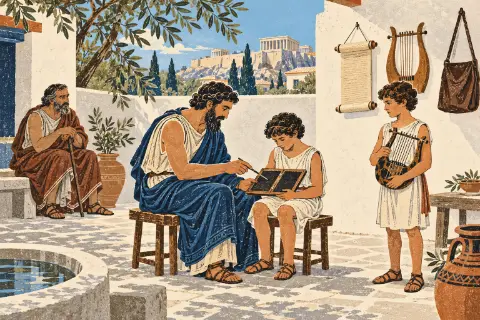
Boys whose families could pay for a teacher learned the lyre. Plato (Protagoras 326a) says that the music teacher, the κιθαριστής, taught boys to play and then to sing the poems of good poets. Vase paintings show such lessons. Most girls did not go to a teacher, but they could learn music and dance at home.
Test yourself: 4 words from this page
1 / 4
What does this word mean?
Lyre and kithara: instruments with strings
An old Greek poem, the Homeric Hymn to Hermes, tells how the lyre was invented. The baby god Hermes found a tortoise outside his cave. He used its shell as the body and fixed pieces of reed in it. He stretched oxhide over it, added two arms and a crossbar, and then seven strings of sheep gut, the χορδαί. He tried out the λύρα with a πλῆκτρον, a small pick for striking the strings (lines 24–53).
Real lyres often had a tortoise-shell body covered with oxhide, and they usually had seven strings. Few survive, because the materials rot, so we know them mostly from vase paintings. A lyre was light and fairly easy to learn, so teachers often used it with children.
The κιθάρα (kithara) was a large lyre with a wooden sound box. Musicians played it standing, at processions, ceremonies and contests. Some professional players won fame and money. Plutarch (Pericles 13) says that Pericles brought contests in aulos, singing and kithara to the Panathenaia festival in Athens. People watched them in a concert hall, the ᾠδεῖον (Odeion).
The aulos and the Pan pipes
People often translate αὐλός as “flute”, but it was not a flute. Each pipe had finger holes and a reed in the mouthpiece. Players usually blew two pipes at once, a little like playing two oboes together. Some pictures show a strap around the player’s head, which helped with the playing. No ancient reeds survive, and scholars still discuss how the two pipes sounded together.
The aulos played at drinking parties, at sacrifices and with the choruses of tragedy. In the early 5th century BC it was very fashionable in Athens, but later it fell out of favour there. Aristotle (Politics 1341a–b) did not want it in school, because a player cannot speak while blowing. He also tells a myth: the goddess Athena found the aulos and threw it away, and some said this was because it spoiled her face. Pausanias (1.24.1) saw a statue on the Acropolis of Athena striking Marsyas, who had picked it up.
The σῦριγξ (syrinx) was a row of pipes of different lengths, the Pan pipes. In the hymn, Hermes makes one after he has given the lyre to Apollo (lines 511–512). Homer also mentions it (Iliad 10.13).
Reading the tunes, and the words today
The Greeks mostly learned music by ear, but they also had a way to write it: letters and other signs above the words. Only about fifty pieces or fragments survive. Hymns to the god Apollo were carved on the outer wall of the Athenians’ treasury at Delphi in the 2nd century BC, and they were found in 1893, broken. A gravestone from near Aydın in today’s Türkiye carries a short song, with words and notes, by a man called Seikilos. It is usually dated to the 1st or 2nd century AD and is widely considered the oldest complete piece of music. It is now in the National Museum of Denmark.
Many of the words also live on in Greek, often with a new job:
- λύρα: today also the Cretan lyra, a folk instrument with three strings, played with a bow. It is not the ancient lyre.
- πλήκτρο: a plectrum, but also a key on a piano or a computer keyboard.
- ωδείο: a music school, and also an ancient music building, like the Odeon of Herodes Atticus in Athens.
- σύριγγα: the Pan pipes, but also a doctor’s syringe. The name reached the syringe through Latin and French.
Key dates
- 5th c. BCIn the time of Pericles, music contests at the Panathenaia are held in the Odeion of Athens.
- 418 BCSpartan soldiers advance to the sound of the aulos at the battle of Mantinea.
- 4th c. BCAristotle writes that the aulos does not belong in school.
- 2nd c. BCHymns to Apollo, with their music, are carved on a wall at Delphi.
- 1883The gravestone with the song of Seikilos first comes to light.
- 1893The hymns to Apollo are found at Delphi.
Eight words, then and now
| Ancient Greek | Greek today | Meaning |
|---|---|---|
| music, art of the Muses | ||
| lyre, today also Cretan lyra | ||
| reed pipe, not a flute | ||
| large lyre, now guitar | ||
| string of an instrument | ||
| plectrum, now also a key | ||
| Pan pipes, now also syringe | ||
| music hall, now music school |
 The symposium: the Greek drinking party
 School and education in ancient Greece
 Greek theatre: tragedy, comedy and masks