
The story in short
The Iliad, Ἰλιάς, is a long poem about the Trojan War, the war of the Greeks against the city of Troy, which the Greeks also called Ilion, Ἴλιον: that is where the title comes from. The Greeks have been camped outside Troy for nine years. The poem tells only what happens in some weeks of the tenth year, about fifty days. Its hero, the ἥρως, is Achilles, the best fighter of the Greeks.
Achilles quarrels with Agamemnon, the leader of the army, and stops fighting. Without him, the Greeks lose battle after battle. His friend Patroclus goes into battle in Achilles’ armour and is killed by Hector, the greatest Trojan warrior. Mad with grief, Achilles returns, kills Hector and drags his body behind his chariot. At the end, old King Priam, Hector’s father, comes at night to Achilles’ hut and begs for his son’s body. Achilles weeps with him and gives it back.
Test yourself: 4 words from this page
1 / 4
What does this word mean?
Books 1–9: the wrath of Achilles
The first word of the poem is μῆνιν, “wrath”: «μῆνιν ἄειδε θεὰ Πηληϊάδεω Ἀχιλῆος», “Sing, goddess, the wrath of Achilles, son of Peleus”. In Book 1, Agamemnon refuses to free Chryseis, the daughter of a priest of Apollo, and the god sends a plague on the camp. Agamemnon gives the girl back, but takes Briseis, Achilles’ prize, in her place. Achilles stays by his ships, and his mother, the sea goddess Thetis, asks Zeus to let the Trojans win for a time.
Book 2 lists the Greek forces in the “Catalogue of Ships”. In Book 3, Paris, who had carried off Helen, fights a duel with Menelaus, her husband. In Book 6, Hector says goodbye to his wife Andromache near the city gate; their baby son is frightened by the horsehair crest of his father’s helmet, and Hector takes it off. In Book 9, Odysseus, Ajax and Phoenix bring Achilles Agamemnon’s offer of gifts. He refuses, and explains his choice: a short life with κλέος ἄφθιτον, “undying glory”, or a long life at home without fame (9.410–416).
Books 10–24: Patroclus, Hector and Priam
In the next books, the Trojans push the Greeks back to their ships. In Book 16, Patroclus puts on Achilles’ armour and drives the Trojans away from the ships, but Apollo strikes him, and Hector kills him. In Book 18, Thetis asks the smith god Hephaestus to make new armour for her son, with a great shield, an ἀσπίς, that shows a city at peace, a city at war, fields, vineyards and a dance.
In Book 22, Achilles chases Hector three times around the walls and kills him. Dying, Hector foretells that Paris and Apollo will kill Achilles at the Scaean gate (22.359–360). Achilles pierces the tendons of Hector’s feet «ἐς σφυρὸν ἐκ πτέρνης», “from the heel to the ankle”, ties him to his chariot and drags him away (22.396–398). Book 23 describes the funeral of Patroclus and the games held in his honour, a chariot race, boxing, wrestling and a foot race. In Book 24, the god Hermes leads Priam through the Greek camp, and Achilles gives back the body. The poem ends with Hector’s funeral: «ὣς οἵ γ᾽ ἀμφίεπον τάφον Ἕκτορος ἱπποδάμοιο», “so they held the funeral of Hector, tamer of horses”.
What the Iliad does not tell
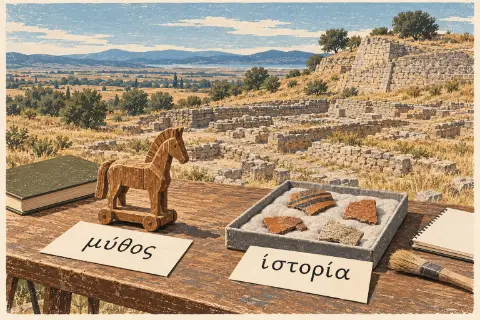
Many people think that the Iliad tells the whole Trojan War. It does not. It begins in the tenth year and covers only some weeks, about fifty days (the World History Encyclopedia counts 52). The start of the war, the judgement of Paris and the taking of Helen, is only mentioned in passing. The death of Achilles is foretold but not shown. The wooden horse is not in the Iliad at all: it appears in the Odyssey, where the singer Demodocus sings of it (8.492–520), and later in Virgil’s Aeneid. These events were told in other epic poems, now lost, and by later writers.
The famous heel is not from Homer either. In the Iliad, Achilles can be wounded: a spear grazes his forearm in Book 21. The Roman poet Statius, in his Achilleid (1st century AD), has Thetis say that she dipped her baby in the river Styx, “would that I had done it wholly!”, and later tellings add that the heel she held him by stayed weak. Who Homer was, and whether a real war lies behind the poem, are still debated. The Iliad, more than 15,000 lines in 24 books, probably took its form in the 8th century BC, from a long tradition of oral song.
Key dates
- 8th c. BCThe Iliad probably takes its written form, after a long oral tradition
- 1st c. ADStatius’ Achilleid: Thetis dips the baby Achilles in the Styx
Eight words, then and now
| Ancient Greek | Greek today | Meaning |
|---|---|---|
| wrath | ||
| glory, lasting fame | ||
| hero | ||
| epic poem (ancient: word) | ||
| shield | ||
| heel (πτέρνα in the idiom) | ||
| tendon | ||
| contest, match, struggle |
 Was the Trojan War real? Myth and archaeology