
What the word ἥρως meant
The meaning of ἥρως depends on the source. In Homer it is a title of honour for free men, above all the warriors at Troy, but it can also describe the bard Demodocus (Odyssey 8.483). In such passages it does not refer to worship.
Hesiod gives a different picture. In the Works and Days (156–173) the heroes are the fourth race of mankind, ἀνδρῶν ἡρώων θεῖον γένος, “who are called ἡμίθεοι”, demigods. War destroyed them at Thebes and Troy, and some now live in the Islands of the Blessed.
In classical texts a hero is often a dead person honoured with cult, and not always a figure of myth. Herodotus (5.47) says that the people of Egesta built a shrine on the grave of Philippus of Croton, an Olympic victor, because of his beauty. According to Pausanias (1.32.4), the Marathonians worshipped the men who fell in the battle, calling them heroes.
Test yourself: 4 words from this page
1 / 4
What does this word mean?
Glory and excellence: κλέος and ἀρετή
Epic heroes seek κλέος, the fame that other people speak of; the word is related to κλύω, “hear”. Achilles sets out the exchange at Iliad 9.413: if he stays at Troy, ὤλετο μέν μοι νόστος, ἀτὰρ κλέος ἄφθιτον ἔσται, “my homecoming is lost, but my fame will never perish”.
The way to fame is ἀρετή. We often translate it as “virtue”, but in Homer it means excellence of any kind, especially prowess: Iliad 20.411 can speak of ποδῶν ἀρετή, excellence of the feet. For the sense of moral virtue, the dictionary LSJ cites classical prose writers such as Democritus, Xenophon and Plato. Modern Greek has followed them: αρετή is a virtue or a good quality, while κλέος survives as an elevated word for glory.
Pindar brings poem and cult together. In Olympian 1.90–93 Pelops lies by the Alpheus and receives αἱμακουρίαι, offerings of blood, at his tomb beside the altar; the next words turn to κλέος: the fame of the Olympic games shines from afar in the races of Pelops.
Cult: bones, cities and sacrifice
Cult tied a hero to a place, so bones mattered. Herodotus (1.67–68) tells how Delphi ordered the Spartans to bring home the bones of Orestes in order to defeat Tegea. Plutarch (Theseus 36) says that after the Persian Wars the Pythia told the Athenians to recover the bones of Theseus; Cimon took Skyros and brought back the coffin of a huge body, with a bronze spearhead and a sword. The tomb in Athens became a refuge for slaves and the poor.
Cults also served politics. At Amphipolis (Thucydides 5.11) the tomb of the Spartan general Brasidas received sacrifices, games and yearly offerings, and he replaced the Athenian Hagnon as founder of the colony. Cleisthenes gave Athens ten tribes named after heroes (Herodotus 5.66).
What was the rite? Handbooks long set heroes apart from gods, with blood rituals, whole burnt offerings and the verb ἐναγίζειν. Gunnel Ekroth (2002) concludes from inscriptions and texts that the main rite was a θυσία at which worshippers ate the meat. On her reading the other rites were marginal, and ἐναγίζειν is seldom used for heroes before the Roman period.
When did hero cult begin? An open question
Archaeology offers evidence but no simple answer. Later Greeks left offerings in Mycenaean tombs, for example in Messenia and at Prosymna in the Argolid, and many of these deposits belong to the Geometric and Archaic periods. J. N. Coldstream, in “Hero-cults in the age of Homer” (1976), argued against the idea of a continuous memory running through the Dark Age; his work is often cited for a link between these cults and the spread of epic.
James Whitley (1988) replied that such general explanations ignore local differences. Comparing Attica and the Argolid, he linked those differences to the different ways in which early states formed. He also rejected the excavators' view that the great tenth-century building at Lefkandi was a heroon, calling it “extremely unlikely” and noting that it had not won general acceptance.
Ekroth, for her part, questions whether hero rituals grew out of the cult of the dead at all. No single theory of origins is accepted today, so it is safest to state which evidence each view relies on.
Key dates
- 10th c. BCA large building at Lefkandi, called a heroon by its excavators; the label is disputed
- 8th c. BCOfferings at old Mycenaean tombs and early presumed hero shrines; their meaning is debated
- 508/7 BCCleisthenes' reforms in Athens: ten tribes named after heroes
- 5th c. BCAfter the Persian Wars, Cimon brings the “bones of Theseus” from Skyros, according to Plutarch
- 422 BCBrasidas dies at Amphipolis and receives a hero's honours there
- 4th c. BCThe Monument of the Eponymous Heroes, with ten bronze statues, stands in the Athenian Agora
Eight words, then and now
| Ancient Greek | Greek today | Meaning |
|---|---|---|
| hero | ||
| war memorial; once hero's shrine | ||
| glory, fame | ||
| excellence; now virtue | ||
| demigod | ||
| tomb, grave | ||
| sacrifice | ||
| monument, memorial |
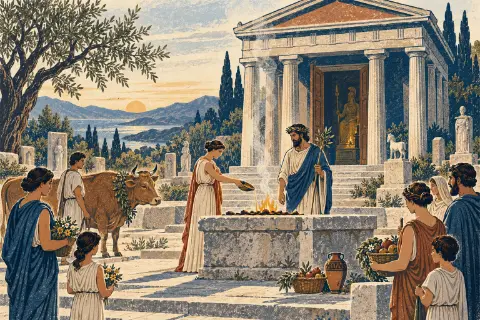 Greek religion: temples, priests and sacrifices
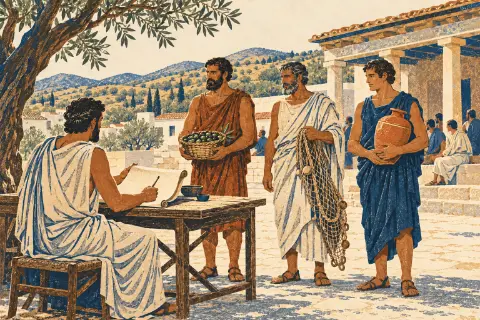 Cleisthenes and the birth of democracy (508 BC)