
The story in short
Antigone is a tragedy by Sophocles of Athens, set in the city of Thebes on the morning after a war. Two brothers, Eteocles and Polynices, have killed each other in battle. Polynices had come with an enemy army from Argos. Their uncle Creon is now the ruler, and he gives an order: Eteocles will have an honourable burial, but Polynices must stay ἄταφος, unburied, as food for the birds. Anyone who buries him will be stoned to death.
Their sister Antigone refuses to obey. Her sister Ismene is too afraid to help. Antigone scatters dust on the body and pours offerings over it, and the guards catch her. She admits everything. Creon orders her to be shut up alive in a rock tomb, although she is engaged to his son Haemon. Then the blind prophet Tiresias warns him: he has put a living person in a grave and left a dead man above ground, and he will pay with a child of his own. Creon gives way, but too late. Antigone has hanged herself, Haemon kills himself beside her, and Creon's wife Eurydice takes her own life when she hears.
Test yourself: 4 words from this page
1 / 4
What does this word mean?
Her reply to Creon: lines 450–457
Creon asks if she dared to break «these laws», τούσδ᾽ ὑπερβαίνειν νόμους (449). Her answer is the best-known passage of the play. It was not Zeus who proclaimed this, she says, nor Justice, Δίκη, who lives with the gods below. She did not think that his proclamations, κηρύγματα, were strong enough for a mortal to override the gods' «unwritten and unfailing» rules, ἄγραπτα κἀσφαλῆ θεῶν νόμιμα (454–455). These rules, she adds, are not of today or yesterday: ἀλλ᾽ ἀεί ποτε ζῇ ταῦτα, they live forever, and no one knows when they appeared (456–457).
Notice the wording. Sophocles writes ἄγραπτα νόμιμα, not ἄγραφοι νόμοι. The other adjective belongs to writers of the same period and after: Thucydides speaks of laws ὅσοι ἄγραφοι ὄντες (2.37.3), and Xenophon's Socrates asks Hippias about ἀγράφους νόμους (Memorabilia 4.4.19). Aristotle then joins the two. He says that Antigone defends her act as against Creon's law, ἀλλ᾽ οὐ παρὰ τὸν ἄγραφον, «but not against the unwritten one» (Rhetoric 1.15.6), and he reads her lines as a case of what is just by nature (1.13.2). So the exact phrase we use for her argument is Aristotle's wording rather than hers.
The main themes
The play does not make Creon a simple villain. He opens with a reasoned speech: a ruler must put the city first, and he will never count an enemy of the land as a friend (162–190). Each of the themes below grows out of that clash.
- The state's law and an older duty. Creon calls her act ὕβρις (480–482); she appeals to the gods and to her dead. Late in the play he himself fears it may be best to keep «the established laws» to the end of life (1113–1114).
- Family and city. For Creon the enemy stays an enemy even in death. Antigone answers: οὔτοι συνέχθειν, ἀλλὰ συμφιλεῖν ἔφυν, I was born to share in love, not in hatred (523).
- Power and listening. Antigone speaks of τυραννίς (506), and Haemon warns his father: πόλις γὰρ οὐκ ἔσθ᾽ ἥτις ἀνδρός ἐσθ᾽ ἑνός, no city belongs to one man (737).
- Learning too late. The chorus closes on good sense, τὸ φρονεῖν, taught by heavy blows in old age (1347–1353). Its great ode, πολλὰ τὰ δεινά (332), had already shown how much humans can do, and how far they can go wrong.
Its date and its later life
The date of Antigone is not certain. Only two plays by Sophocles, Philoctetes (409 BC) and Oedipus at Colonus (401 BC), have firm production dates. Antigone is usually placed around 442 or 441 BC, partly because of a tradition that its success won Sophocles his election as general in 440 BC, and that story may not be true.
The play has kept finding new audiences. Jean Anouilh's French version opened in Paris in February 1944, during the German occupation, and many saw it as a tribute to the Resistance, although others accused it of indulging the collaborators. In Greece the National Theatre opened the 2025 Epidaurus season with a staging by Ulrich Rasche. In 2017, when teachers feared that Antigone would be dropped from Greek schools, the Institute of Educational Policy replied that its place in the secondary curriculum had never been questioned.
Key dates
- c. 442 BCUsual date for the first performance, though not a certain one
- 4th c. BCAristotle's Rhetoric cites Antigone on the unwritten law
- 1944Anouilh's Antigone opens in occupied Paris
- 2025Ulrich Rasche's staging opens the Epidaurus season
Eight words, then and now
| Ancient Greek | Greek today | Meaning |
|---|---|---|
| law | ||
| unwritten | ||
| grave, tomb | ||
| brother (also αδερφός) | ||
| dead person | ||
| court trial (once also justice) | ||
| sermon (once: public proclamation) | ||
| tyrant (once: sole ruler) |
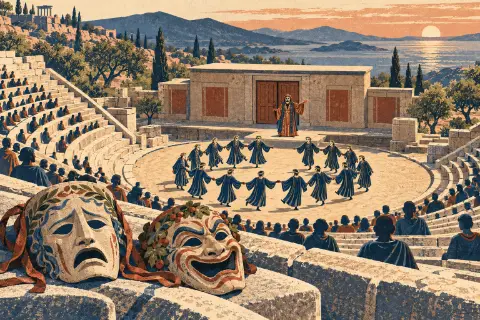 Greek theatre: tragedy, comedy and masks