
A secret festival for Demeter
Eleusis was a town in Attica, some 20 km from Athens. Its sanctuary belonged to Demeter, the goddess of grain, and to her daughter Persephone, who was often called simply ἡ Κόρη, “the Maiden”. In Modern Greek, κόρη is still the everyday word for a daughter.
A poem from around 650–550 BC, the Homeric Hymn to Demeter, tells their story. Hades, the god of the underworld, carried the girl away. Demeter searched for her and came to Eleusis disguised as an old woman. Then she stopped the crops from growing, until Zeus agreed that Persephone could come back. But the girl had to return below for a third of every year. Before leaving, Demeter taught the leaders of Eleusis her rites.
These rites were the Mysteries, τὰ μυστήρια. A person who took part was a μύστης, an initiate, and was not allowed to reveal what had been seen. The poem gives the reason why people came: those who have seen the rites are happy, it says, while the others have no such good fortune after death.
Test yourself: 4 words from this page
1 / 4
What does this word mean?
From Athens to Eleusis
The main festival, the Greater Mysteries, took place in the month of Boedromion (September–October). On the 15th the initiates gathered, and murderers and “barbarians”, people who were not Greek, were excluded. On the 16th they bathed in the sea. After days of fasting, on the 19th they walked behind the statue of Iacchos along the Sacred Way, ἡ ἱερὰ ὁδός, and entered the sanctuary at dusk. These days are a modern reconstruction, and Plutarch (Camillus 19) puts the march on the 20th. In the hymn Demeter refuses wine and asks for barley meal and water with pennyroyal, a kind of mint, the κυκεών, and initiates are said to have drunk it too.
Who could join? Herodotus (8.65) says that any Athenian or other Greek who wished was initiated. He also tells how, in 480 BC, in an Attica left empty, an exile saw dust rising from Eleusis as if from about 30,000 men. The rites seem to have been for Athenians at first; under Rome, initiates came from all over the empire. A speech in the Demosthenic collection (59.21) shows an enslaved woman, Metaneira, being brought to be initiated.
Before the main festival came the Lesser Mysteries, held at Agrai outside Athens in Anthesterion (February–March), which were mainly a purification. A year after initiation, a person could return to reach the highest grade and become an ἐπόπτης, “one who has seen”.
What happened in the hall?
The rites took place in the Telesterion, the τελεστήριον, a square hall. In the second half of the 5th century BC it was enlarged to hold several thousand initiates, who stood on steps along the walls. Our sources disagree about the builders: Strabo (9.1.12) names Ictinus, the architect of the Parthenon, while Plutarch (Pericles 13) names Coroebus, Metagenes and Xenocles. Inside stood the ἀνάκτορον, the inner shrine. The chief priest, the ἱεροφάντης, “the one who shows the sacred things”, was chosen for life from the family of the Eumolpidae.
What was shown is still unknown. Pausanias (1.38.7), who describes Greece in such detail, says that a dream stopped him from describing what lay inside the sanctuary wall. Later evidence gives only glimpses: after a night of darkness the ἀνάκτορον was opened and a great fire blazed out, and the Christian writer Hippolytus says that the hierophant showed an ear of grain, cut in silence. Isocrates (4.28) gives the promise in one phrase: those who share in the rite have “sweeter hopes” about the end of life.
Breaking the secret was serious. In 415 BC Alcibiades was accused of imitating the Mysteries at home and playing the hierophant himself (Thucydides 6.28, Plutarch, Alcibiades 22). Aristotle (Nicomachean Ethics 1111a) gives the poet Aeschylus, with the Mysteries, as an example of not knowing that a matter was secret.
The beginning, the end and the words that survive
Nobody is certain how old the rites are. Fritz Graf sees no demonstrable Bronze Age roots and dates the first sanctuary we can trace to the 8th century BC, while Michael Cosmopoulos, in his study of the excavations, argues for local Bronze Age roots. The end is clearer: Marcus Aurelius rebuilt the sanctuary after an invasion in 170 AD, the emperor Theodosius (379–395) banned the pagan cults, the Mysteries among them, and in 395 or 396 AD invading Goths destroyed the sanctuary. Systematic excavation began in 1882. The archaeologist George Mylonas, who worked at the site, published Eleusis and the Eleusinian Mysteries in 1961.
The words survived better than the rites. Today μυστήριο means a mystery, but also a church sacrament such as baptism. A τελετή, once an initiation, is now any ceremony, and a γραφείο τελετών is an undertaker's office. A μύστης is someone initiated into anything. An επόπτης, once the highest initiate, is now a supervisor, and also a linesman in football. From ἀπόρρητος, “not to be told”, comes τραπεζικό απόρρητο, banking secrecy. And ἀνάκτορον, the shrine of a god, became ανάκτορα, a royal palace.
Key dates
- 8th c. BCEarliest sanctuary at Eleusis that archaeology can trace, according to Fritz Graf
- c. 650–550 BCApproximate date of the Homeric Hymn to Demeter
- 5th c. BCThe Telesterion is enlarged to hold several thousand initiates
- 415 BCAlcibiades is accused of imitating the Mysteries at home
- 170 ADAn invasion leads Marcus Aurelius to rebuild the sanctuary
- 395/396 ADInvading Goths destroy the sanctuary, after Theodosius's ban on pagan cults
- 1882Systematic excavation of the sanctuary begins
- 2023Elefsina is a European Capital of Culture
Eight words, then and now
| Ancient Greek | Greek today | Meaning |
|---|---|---|
| secret rite; mystery, sacrament today | ||
| initiate | ||
| highest initiate; supervisor today | ||
| priest who shows sacred things | ||
| initiation; any ceremony today | ||
| not to be told, confidential | ||
| god's shrine; palace today | ||
| the Maiden; daughter today |
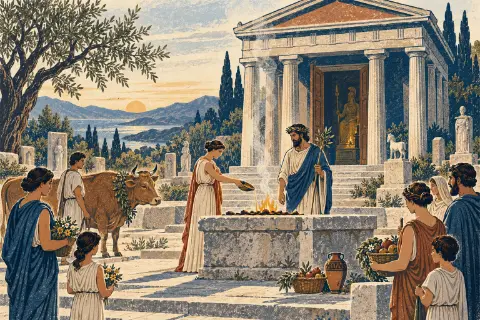 Greek religion: temples, priests and sacrifices
 Greek and Roman gods: the names compared
 The Battle of Salamis: the sea battle that saved Greece