
A city between two seas
Look at a map of Greece. The Peloponnese is joined to the mainland by a narrow strip of land, an isthmus, in Greek ἰσθμός. Corinth, Κόρινθος, stood beside this strip, under a steep rock called Acrocorinth, Ἀκροκόρινθος.
The city had two harbours, one on each sea. Lechaion, Λέχαιον, served ships from Italy, and Kenchreai, Κεγχρεαί, served ships from Asia (Strabo 8.6.22). Sailors feared the long way round the Peloponnese, past stormy Cape Malea. Strabo (8.6.20) quotes a saying about it: “round Malea and forget your home”. So merchants were glad to stop at Corinth instead.
That is why the city grew rich. Homer already calls it ἀφνειός, “wealthy” (Iliad 2.570), and Thucydides (1.13) says it always had a market. Strabo (8.6.21) also repeats a myth: at the spring of Peirene, on Acrocorinth, the hero Bellerophon caught the winged horse Pegasus while it was drinking.
Test yourself: 4 words from this page
1 / 4
What does this word mean?
Tyrants, shipbuilders and potters
Around 750 BC a single family, the Bacchiads, held power. Around 657 BC a man called Cypselus, Κύψελος, overthrew them and ruled alone as a τύραννος. In ancient Greece the word meant a ruler who had taken power by force or outside the law; today it means above all a cruel ruler. Herodotus (5.92) says that as a baby Cypselus was hidden from killers in a chest, a κυψέλη, and was named after it. In Greek today κυψέλη means a beehive. His son Periander, Περίανδρος, followed him around 627 BC and died in the 580s BC; sources give different years.
Corinthians founded Syracuse in Sicily and settled Corcyra, modern Corfu, traditionally around 733 BC. Thucydides (1.13) reports that they are said to have built the first triremes in Greece, and names a Corinthian shipbuilder, a ναυπηγός, called Ameinocles. He also records the oldest sea battle he knew of, between Corinth and Corcyra.
Corinth's potters invented the black-figure technique: dark silhouettes with details scratched in. Their small oil flasks, the aryballoi, spread widely in the 7th century BC. Herodotus (2.167) adds that Corinthians looked down on craftsmen less than other Greeks did.
From the diolkos to the canal
Ships could avoid Malea altogether if they crossed the isthmus by land. Strabo (8.6.22) calls the crossing the δίολκος. The archaeologist Nikolaos Verdelis excavated a stone-paved road here from 1956 and dated it to around 600 BC, the time of Periander. Its paving has grooves, which he read as guides for wheels.
Thucydides (8.7–8) tells how the Spartans in 412 BC planned to bring ships over the isthmus. Most historians now think warships were not hauled across regularly, and that wagons mainly carried heavy goods, perhaps timber or marble.
People also dreamed of a canal, a διῶρυξ, a word already used by Herodotus. Pausanias (2.1.5) saw the place where someone had tried to dig and had given up. Other sources name the emperor Nero, in AD 67. The canal, διώρυγα in Greek today, finally opened in 1893. It is about 6.3 km long, and it cut through parts of the old road. Greeks still speak of ο Ισθμός της Κορίνθου.
Destroyed, rebuilt, dug up
Corinth stayed famous. Euripides set his Medea there, and Plutarch (Alexander 14) places the meeting of Alexander and Diogenes near the city. Then, in 146 BC, the Roman general Lucius Mummius destroyed it (Pausanias 7.16; Strabo 8.6.23). Strabo reports, from the historian Polybius who was there, that soldiers played board games on famous paintings thrown on the ground.
Strabo says the city then lay empty for a long time, until Julius Caesar sent settlers, mostly freed slaves; the colony is dated to 44 BC. The settlers dug up old graves and sold the pots in Rome as νεκροκορίνθια. In this Roman Corinth the apostle Paul stayed for a year and six months (Acts 18:11). His letters to its Christians are titled «Προς Κορινθίους» in Greek.
Today the ruins stand at Αρχαία Κόρινθος. The American School of Classical Studies has dug here since 1896. Seven monolithic columns of the Temple of Apollo, from the mid-6th century BC, still stand. They are Doric, even though the later Corinthian order, κορινθιακός ρυθμός, is named after the city. Modern Corinth was built a few kilometres away after an earthquake in 1858.
Key dates
- c. 733 BCTraditional date of the Corinthian settlements at Corcyra and Syracuse
- c. 657 BCCypselus overthrows the Bacchiads and becomes tyrant
- c. 600 BCThe excavator's date for the paved road across the isthmus
- 146 BCLucius Mummius destroys Corinth
- 44 BCJulius Caesar's colony is founded on the site
- 67 ADNero's attempt to dig a canal, soon abandoned
- 1893The Corinth Canal opens
- 1896The American School begins its excavations
Eight words, then and now
| Ancient Greek | Greek today | Meaning |
|---|---|---|
| Corinth, the city | ||
| of Corinth, Corinthian | ||
| isthmus, neck of land | ||
| harbour (via Turkish liman) | ||
| canal, dug channel | ||
| shipbuilder | ||
| raisin, dried grape | ||
| sole ruler, now a cruel one |
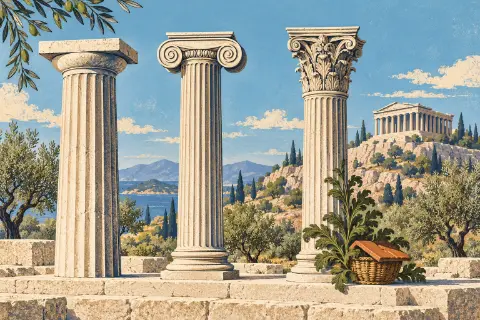 Doric, Ionic and Corinthian columns: the Greek orders
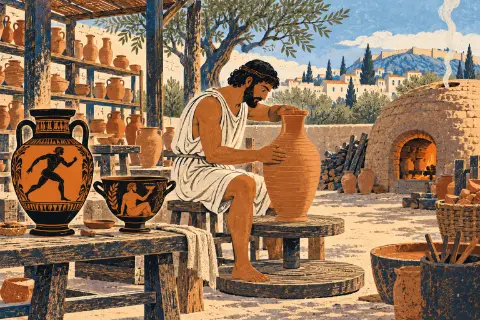 Greek pottery: black-figure and red-figure