
A city on a hill
Mycenae (Μυκῆναι) stands in the north-east of the Peloponnese, on a low hill between two taller ones. From there its rulers could control the plain of Argos and the routes by land and sea. People first lived here more than 8,000 years ago. But most of what you can see today was built between 1350 and 1200 BC, in the Late Bronze Age. A whole civilisation, the Mycenaean, is named after this city.
Homer calls Mycenae πολύχρυσος, “rich in gold” (Iliad 7.180 and 11.46). In his poems it is the city of King Agamemnon, who leads the Greeks to Troy. The Greek Ministry of Culture calls Agamemnon “mythical”: we know him from stories.
The Greeks also told stories about the city's name. The travel writer Pausanias (2nd century AD) reports that the hero Perseus founded the city at the place where the cap of his sword, the μύκης, fell off. He also heard that a thirsty Perseus pulled a mushroom, also called μύκης, out of the ground, and water flowed out (2.16.3). These are legends, not history. But the word lives on: μύκητας is Modern Greek for a fungus.
Test yourself: 4 words from this page
1 / 4
What does this word mean?
Walls of giants, gate of lions
A huge wall, a τεῖχος, runs around the top of the hill. All the way round it measured close to 900 metres. On the north side it is up to 7.5 metres thick and nearly 12 metres high. It was built in stages, starting about 1350 BC, from enormous rough blocks of stone. Pausanias says people called the walls and the gate the work of the Κύκλωπες, the Cyclopes, giants of myth (2.16.5). Archaeologists still speak of Cyclopean walls.
About 1250 BC (some books say a little earlier) the builders added a grand new entrance, the Lion Gate. In Greek it is «Πύλη των Λεόντων»: πύλη means gate and λέων means lion. The everyday word today is λιοντάρι, from λεοντάριον, literally “little lion”.
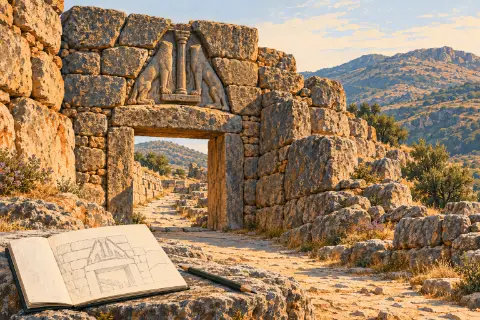
Two tall stones hold up one giant stone, the lintel. It is about 4.5 metres long and weighs about 18 tons. Above it the builders left an empty triangle, so that the wall would not press on the lintel. A carved slab fills the triangle: two lions stand on either side of a column. Their heads are lost. They were made separately and fixed on, and they looked out at anyone coming to the gate.
The gate is one of the oldest large sculptures known in Europe. Pausanias saw it too: “λέοντες δὲ ἐφεστήκασιν αὐτῇ”, “lions stand on it”.
Gold from the royal graves
Just inside the gate lies Grave Circle A, a ring of six deep graves. A grave is a τάφος, in Ancient and in Modern Greek. Rulers were buried here in the 16th century BC with gold, cups, rings and weapons. When the new wall was built, the old circle was brought inside the city and repaired, and it was used to honour the ancestors.
In 1876 Heinrich Schliemann, who was fascinated by Homer, began digging here and uncovered five graves. P. Stamatakis, who continued the work, uncovered the sixth. The graves held a treasure of χρυσός, gold, including five gold masks. The Greek word προσωπεῖον, “mask”, comes from πρόσωπον, “face”. Modern Greek has προσωπείο, and also the everyday word μάσκα.
Schliemann believed that he had found the body of Agamemnon, so one mask is still called the Mask of Agamemnon. Modern studies date it to about 1550–1500 BC, about three centuries before the time when Agamemnon is supposed to have lived. So the name is wrong, but it has stayed. A few scholars have asked whether Schliemann faked or changed this mask. Others reply that there is no proof of that.
After the palace
About 1200 BC a great destruction hit Mycenae, probably caused by an earthquake. The walls were extended again to reach an underground water supply. More destruction and fires followed, and about 1100 BC the great city was abandoned. After that only a few people lived on the hill.
Mycenae still played a small part in later history. Pausanias says that it sent eighty men to Thermopylae against the Persians, while Argos stayed at home. Out of jealousy, he says, the Argives destroyed Mycenae (2.16.5). The Ministry of Culture dates the conquest to 468 BC. When Pausanias came in the 2nd century AD, the town was in ruins, but parts of the wall and the gate with its lions still stood.
In 1841 K. Pittakis of the Greek Archaeological Society cleared the Lion Gate. Since 1999 Mycenae and nearby Tiryns have been on the UNESCO World Heritage List.
Key dates
- c. 1600 BCGrave Circle A is built on the hill.
- c. 1350 BCWork begins on the palace and the first Cyclopean wall.
- c. 1250 BCA new wall and the Lion Gate are built.
- c. 1200 BCA great destruction, probably an earthquake.
- c. 1100 BCThe great city is abandoned.
- 468 BCArgos conquers Mycenae.
- 1841K. Pittakis clears the Lion Gate.
- 1876Schliemann starts digging Grave Circle A.
Eight words, then and now
| Ancient Greek | Greek today | Meaning |
|---|---|---|
| lion (formal: λέων) | ||
| gate | ||
| city wall | ||
| one-eyed giant | ||
| gold | ||
| grave | ||
| mask (everyday word: μάσκα) | ||
| museum (once a Muses' shrine) |
 The Mycenaeans: the world of Agamemnon
 Was the Trojan War real? Myth and archaeology
 Linear B: the oldest Greek writing