
A shape for every job
The ancient word for a pot or container is ἀγγεῖον. Today Greeks say αγγείο for an ancient pot in a museum, and the same word also means a blood vessel. A modern flower vase is a βάζο, a word that comes from Italian vaso.
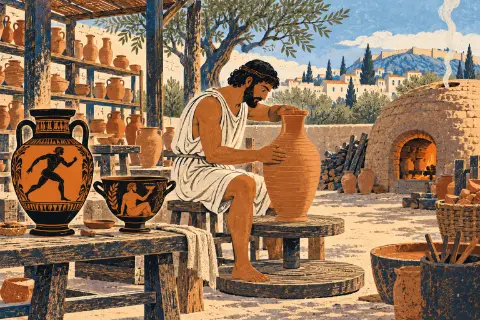
Greek potters had about 20 main shapes to choose from, though experts count them in different ways. The shape of a pot depended on its job. Look at these three things:
- Handles. Two side handles help you lift a heavy pot. One upright handle helps you pour.
- Mouth. A wide mouth is good for mixing or drinking. A small pot with a narrow mouth was probably kept closed, so it suited perfumed oil.
- Size. A storage jar can be very big. An oil pot for an athlete is very small.
One warning about the names. Many of them were given to the shapes by scholars in the 18th and 19th centuries, who matched words from old books and inscriptions to the pots. So a museum label may not say exactly what an ancient Greek said. For an ancient Greek, a κύλιξ could be any wine cup.
Test yourself: 4 words from this page
1 / 4
What does this word mean?
Storing and carrying: amphora and hydria
The ἀμφορεύς (amphora) is a big jar with two handles. Its name is a shorter form of Homer’s word ἀμφιφορεύς, linked to φέρω, “I carry”. People used it to store or carry olive oil, wine and honey. The soldier and writer Xenophon even tells of jars full of salted dolphin meat, found in villages on his long march (Anabasis 5.4.28).
Some amphoras were prizes. At the Panathenaic games in Athens, winners received amphoras of olive oil from the sacred trees of Athena. One of them, now at Harvard, was made in 340–339 BC and is 80 cm high. It shows Athena, and painted words say that it comes “from the games at Athens”. According to the museum, a winning boxer received 60 amphoras of oil.
The ὑδρία (hydria) was a water jar, and its name comes from ὕδωρ, water. It has three handles. The two at the sides were for lifting it when it was full. The upright one at the back was for pouring or for carrying it empty. Vase paintings show hydriai at public fountains. A hydria could also hold voting tokens or the ashes of the dead.
At the party: krater, jug and cup
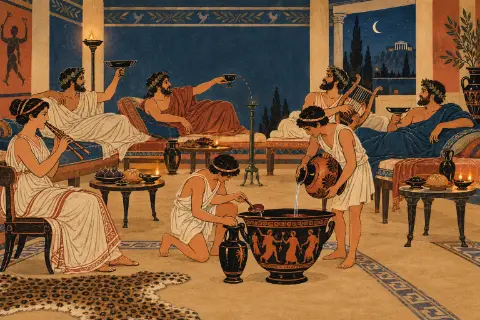
At a drinking party, the συμπόσιον, Greeks mixed their wine with water before they drank it. They did this in a large bowl with a wide mouth, the κρατήρ (krater). The word is linked to the verb κεράννυμι, “I mix”. That old verb is still alive. It gave the modern verb κερνάω, “I treat someone”, so a Greek friend who says «σε κερνάω» is offering to buy your drink. Even κρασί, the everyday word for wine, comes from κρᾶσις, “mixing”.
Next came the οἰνοχόη (oinochoe), a jug. It took wine from the krater and poured it into the cups. Its name contains the word οἶνος, wine. The poet Hesiod gave a strange warning about it: never put the jug on top of the krater while people are drinking, because a deadly fate comes with it (Works and Days 744).
Finally, the wine reached the κύλιξ (kylix), a wide, shallow cup with two handles and a thin foot. It was in use from the early 6th century BC, and it is often linked with scenes of drinking parties. Another cup with two handles was the σκύφος (skyphos).
Oil and beauty: lekythos, aryballos and pyxis
The λήκυθος (lekythos) is a narrow flask with one handle. It held oil, which people used for lamps, for cooking and as perfume. The word is very old. In Homer’s Odyssey (6.79), a mother gives her daughter, Princess Nausicaa, oil in a golden λήκυθος to take to the river, so that she can rub it on after washing.
The lekythos also had a sad job. A museum at Princeton explains that these vases held perfumed oil for burials. Mourners placed them in the tomb, and later visitors brought more to the grave. They used the oil to honour the dead person and the grave monument.
The ἀρύβαλλος (aryballos) was a very small pot of perfumed oil. Athletes rubbed the oil on themselves before and after exercise. The πυξίς (pyxis) was a round box with a lid, used for cosmetics. The word first meant a box made of boxwood. Today πυξίδα has a new job in Greek: it is a compass, a meaning modelled on Italian bussola.
Key dates
- 6th c. BCThe kylix, the wide wine cup, is in use from the start of this century.
- c. 430–420 BCLekythoi now at Princeton are made for burial rituals.
- 340–339 BCA prize amphora for the Panathenaic games is made, now at Harvard.
- 2nd c. BCThe historian Polybius, quoted by Strabo, calls the mouths of a volcano κρατῆρες.
Eight words, then and now
| Ancient Greek | Greek today | Meaning |
|---|---|---|
| vessel; today also blood vessel | ||
| two-handled storage jar | ||
| three-handled water jar | ||
| mixing bowl; today volcano crater | ||
| wine jug | ||
| shallow two-handled wine cup | ||
| narrow oil flask | ||
| lidded box; today a compass |
 Greek pottery: black-figure and red-figure
 The symposium: the Greek drinking party