

A home for a god
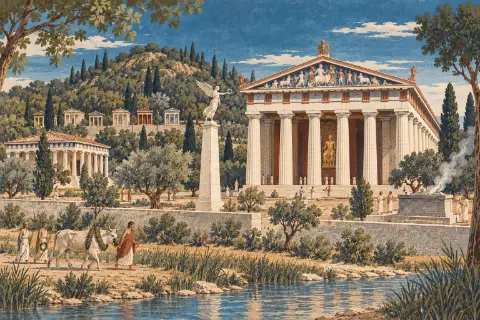
A Greek temple, a ναός, was not a place where crowds came to pray. It was the home of a god's statue, and a gift from the whole city to the gods. People worshipped outside, in the open air. In front of the entrance stood the altar, the βωμός. There people made offerings and sacrifices: fruit, honey, wine or animals. The altar was placed so that the statue inside could "see" it. The front of most temples faced east.
In Athens, building a temple was a decision for the citizens. Someone proposed it in the Assembly, and the citizens voted. Then they chose a committee to check the work and the money, and an architect, the ἀρχιτέκτων. He wrote an exact description of the building. The accounts were cut into marble slabs and set up in public places, so every citizen could read how the money was spent.
Test yourself: 4 words from this page
1 / 4
What does this word mean?
The plan: steps, rooms and columns
A temple had three layers, from bottom to top: a base, a body and a roof.
Under the ground were the foundations, the θεμέλια, big stones that carried the whole weight. On top of them stood the κρηπίς, a stone platform with three steps. The top step was called the στυλοβάτης, because the columns were set right on it.
Behind the columns was a closed building with walls. Its main room was the σηκός (in Latin, cella), where the statue of the god stood. In front of it was a porch, the πρόναος, and large temples had a second porch at the back, the ὀπισθόναος.
The largest temples had a row of columns on all four sides. On the long sides there were usually twice as many columns as on the front, plus one. The Parthenon in Athens has 8 columns at each end and 17 along each side.
From the quarry to the building site
The work began far away, in the quarry, the λατομείο. The best stone was white marble, but few temples were built of marble. Most were built of cheaper local stone, such as limestone. The temple of Zeus at Olympia, for example, was built of local stone, but its roof tiles were of marble. Roofs had wooden beams, and many temples had tiles of baked clay.
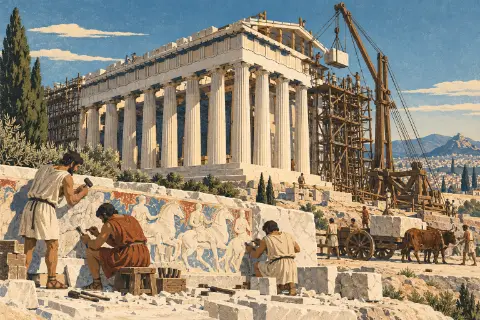
To cut a block, workers made deep cuts in the rock. Then they hammered iron wedges into the cuts until the stone split off. Each block was cut close to its final size, because carrying stone was very expensive. A thin extra layer was left on it, to protect the surface on the way.
Sledges slid the blocks down a stone road from the quarry. Then carts pulled by many pairs of oxen or mules took them to the building site. On the Acropolis of Athens, the loads went up ramps. The marble of the Parthenon came from Mount Pentelikon, less than 20 kilometres away.
Lifting and joining the stones
Heavy blocks were lifted with cranes, wooden machines with ropes. Builders tied the ropes into grooves cut in the stone, or around small knobs left on purpose. After lifting, the knobs were cut away.
Greek builders used no mortar, no "glue" between the stones. The blocks were cut so perfectly that their weight held them in place. Some joints of the Parthenon are thinner than a hundredth of a millimetre! Iron clamps, shaped like a double T, joined each block to the next. Workers poured hot lead around the iron, to protect it from rust and to soften the shock of earthquakes.
A column was a pile of stone drums. In the middle of each drum was a square hole with a block of wood and a wooden pin, which kept the drums in line. At the Erechtheion in Athens, the grooves of the columns were carved after the columns stood in place. Its accounts from 408/7 BC list the teams who did it: citizens and slaves worked side by side, for the same pay.
Key dates
- 620 BCGreek builders begin to use cut stone blocks for temples, instead of wood and mud brick.
- 6th c. BCStone becomes the usual material for the most important temples.
- 447–438 BCThe Athenians build the Parthenon on the Acropolis.
- 408/7 BCThe Erechtheion accounts record the pay of the workers who carve the grooves of its columns.
- 1975Greece sets up a committee to protect and restore the monuments of the Acropolis.
Eight words, then and now
| Ancient Greek | Greek today | Meaning |
|---|---|---|
| architect (chief builder) | ||
| foundation | ||
| stepped base of a temple | ||
| top step under the columns | ||
| room of the god's statue | ||
| altar (also in churches) | ||
| quarry (also νταμάρι) | ||
| crane (bird, later machine) |
 The Parthenon: building, sculptures and story
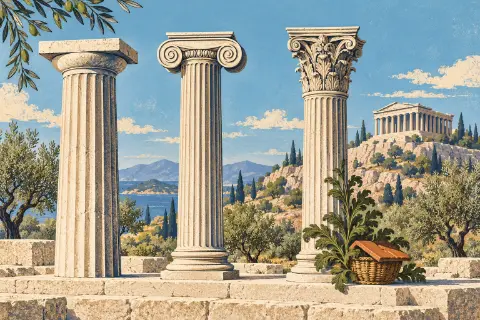 Doric, Ionic and Corinthian columns: the Greek orders
 Olympia: the sanctuary of Zeus