
What fell, and why the label is disputed
The Mycenaean world began to break up in the late 13th century BC. The National Archaeological Museum in Athens lists unrest, economic decline, movements of peoples and earthquakes among the causes; the palace of Pylos burned around 1200 BC, and the Mycenaean age ended in the 11th century. With the palaces went the scribes, and with them Linear B, a script used mainly for lists and inventories. Scarre and Fagan call it a “decapitation”: the elite vanished, while villagers and farmers stayed, with their oral traditions.
What followed is called the Dark Ages, in Greek «σκοτεινοί χρόνοι» (σκότος, darkness). Dates vary: 1100–800 BC in the Centre for the Greek Language's Homer guide, c. 1200–800 BC in the World History Encyclopedia. Population and farming fell, and monumental stone building stopped. Two points remain open. The Greek guide still links the period to the descent of the Dorians, whereas the Encyclopedia reports that an invasion has been rejected in favour of a migration. And “dark” may say more about our lack of written sources than about life at the time.
Test yourself: 4 words from this page
1 / 4
What does this word mean?
Not so dark: Lefkandi and Cyprus
The strongest evidence against a simple picture comes from Lefkandi on Euboea. At Toumba in 1981, British and Greek archaeologists found a building 50 m long and 10 m wide, dated to around 950 BC. Under its central room lay a cremated man in a Cypriot bronze amphora, with an iron sword and spearhead; beside him a woman with gold jewellery, including a Syrian necklace of around 1700 BC; and four horses. Irene Lemos, who directs the project, says the building has been interpreted as funerary. Some call it a heroon, ἡρῷον, a hero's shrine; in today's Greek an ηρώο is usually a monument to the war dead.
Iron itself marks the age. Hesiod says of his bronze race μέλας δ᾽ οὐκ ἔσκε σίδηρος, “there was no black iron” (Works and Days 151). And Greek was being written somewhere: a bronze spit from a tomb at Palaepaphos-Skales on Cyprus, dated 1050–950 BC, carries the name Opheltas in a syllabic script, and Yves Duhoux calls it the most ancient Cypriot text in Greek.
Memory in song: the ἀοιδός
Without writing, what people remembered had to be sung. The Odyssey shows the singer at work: the herald leads in Demodocus, the θεῖον ἀοιδόν, to whom the Muse gave sweet song (8.43, 8.62–64). In the theory proposed by Milman Parry around 1930, such a singer composed as he performed, from a traditional stock of phrases fitted to the hexameter. The language of the epics mixes layers of Greek from the Mycenaean age to about 700 BC; that real events of the Mycenaean period survived through this tradition remains a hypothesis. On the prevailing view, the two poems reached a fixed form in the mid to late 8th century.
Epic was not the only oral art. At Iliad 24.720–723, beside Hector's body, singers lead the dirges (ἀοιδοὺς θρήνων ἐξάρχους), the women respond, and Andromache begins the lament. Margaret Alexiou suggests that early usage separated the set θρῆνος of such singers from the γόος of kinswomen. And in Iliad 6.168–169 Proetus sends Bellerophon with σήματα λυγρά, “baneful signs” scratched on a folded tablet; Homer does not say what those signs were.
The return of writing
Herodotus (5.58) says that Phoenicians who came with Cadmus brought γράμματα to the Greeks, and that the Ionians, changing a few of them, called them Φοινικήια. Whatever we make of Cadmus, the Semitic background of the Greek alphabet is not in doubt, and the Greeks are credited with adding signs for vowels. The date is less certain. The prevailing view places the transfer in or shortly before the 8th century BC, when the first inscriptions appear. Willemijn Waal argues for around the 11th century, on indirect evidence, supposing that the earliest texts on perishable materials are lost.
The first surviving alphabetic texts are not palace lists. A jug from the Dipylon in Athens (740–730 BC) names “whichever of all the dancers now skips most graciously”, in a verse that the Greek Ministry of Culture's page says recalls Homer. A cup from Pithekoussai on Ischia, of about 725 BC, carries verses about the cup of Nestor. The words show the same history: γράμμα still means a letter, of the alphabet or in the post, while ἀλφάβητος, which LSJ cites only from late grammatical sources, is the younger word.
Key dates
- c. 1200 BCThe palace of Pylos is destroyed by fire.
- 11th c. BCThe Mycenaean world comes to its end.
- 1100–800 BCOne common dating of the Dark Ages; other works begin them earlier.
- 1050–950 BCDate of the Cypriot tomb that held the spit inscribed with the name Opheltas.
- c. 950 BCThe monumental building at Toumba, Lefkandi, with its rich burials.
- 740–730 BCThe Dipylon jug from Athens, among the oldest alphabetic Greek inscriptions.
- c. 725 BCThe inscribed cup of Pithekoussai, on the island of Ischia.
Eight words, then and now
| Ancient Greek | Greek today | Meaning |
|---|---|---|
| bard (today: opera singer) | ||
| epic poem (ancient: word) | ||
| dirge, lament | ||
| darkness (σκοτάδι: its diminutive) | ||
| iron (everyday: σίδερο) | ||
| hero's shrine (today: war memorial) | ||
| letter (of alphabet, by post) | ||
| alphabet (a late word) |
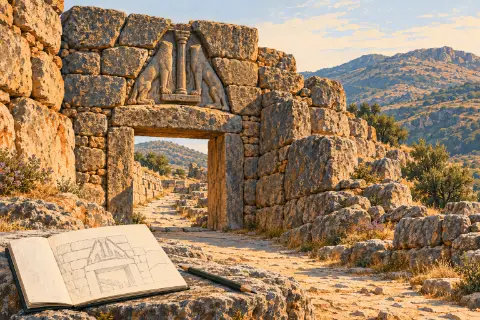 The Mycenaeans: the world of Agamemnon
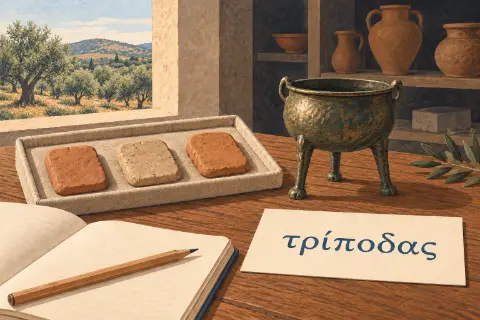 Linear B: the oldest Greek writing