
A real mountain in Greece
Mount Olympus, Ὄλυμπος in Greek, is a real mountain, and you can visit it. It stands in northern Greece, on the border between the Greek regions of Macedonia and Thessaly. It is the highest mountain in the country.
Olympus has several peaks. A peak is a κορυφή. The highest peak is called Mytikas. Sources give its height as 2,917 or 2,918 metres. Another peak, Stefani, is 2,909 metres high and is known as the Throne of Zeus. A θρόνος, a throne, is the special seat of a king.
The ancient Greek word for a mountain was ὄρος. Greeks still know the word όρος, but in everyday talk they say βουνό. That word comes from a different old word, βουνός, which meant “hill”. Herodotus says that people used it in Cyrene, in North Africa.
In 1938 Olympus became the first national park in Greece. In 2026 UNESCO added the wider Olympus area to its World Heritage List, for both its nature and its culture.
Test yourself: 4 words from this page
1 / 4
What does this word mean?
The home of the gods in the old poems
The ancient Greeks told stories about gods who lived on Olympus. These stories are myths, not history, and much of what we know about them comes from two poets, Homer and Hesiod.
In Homer's Iliad, Zeus sits alone on the highest peak of Olympus (1.498–499), and he calls a meeting of the gods there (8.2–3). Each god has a house, built by Hephaestus (1.606–608). The gates of the sky belong to goddesses called the Seasons, the Ὧραι. They open and close a thick cloud, a νέφος (5.749–751).
Hesiod tells how the gods won their home. In his Theogony, the gods of Olympus fight the Titans, who fight from another mountain, Othrys. The war lasts ten full years (632–636). The Cyclopes make the κεραυνός, the thunderbolt, for Zeus (139–141), and in the battle he throws thunderbolts from Olympus (689–692).
These gods are ἀθάνατοι, immortal: they never die. Greeks call them the Olympian gods, after the mountain, and today's dictionary still speaks of the twelve gods of Olympus.
Snow or clear sky? Two pictures in Homer
Homer gives us two different pictures of Olympus. In the Iliad the mountain is snowy: the poet writes Οὐλύμπου νιφόεντος, “of snowy Olympus” (18.616). That sounds like a real high mountain.
The Odyssey is different. There Olympus is the safe seat of the gods. Wind does not shake it, rain does not wet it, and snow, χιών, does not come near it. The sky above it is open and has no clouds, and a white light runs over it (6.42–46). No real mountain is like that, so this picture seems to be a place for gods, not for people.
Be careful not to mix up two names that sound alike. Olympus is the mountain in the north of Greece. Olympia is a sanctuary, a holy place of Zeus, in the west of the Peloponnese, in the south. The ancient Olympic Games took place at Olympia, not on the mountain.
Did people climb it?
Yes, but the evidence is small. In 1961 a weather station was built on a peak called Agios Antonios, 2,817 metres high, and this led to the discovery of old remains. Excavators found burnt earth, probably from an altar, burnt bones of goats and sheep, pottery, coins and pieces of marble slabs with the name Zeus Olympios. The finds show visits from the 4th century BC to about the 5th century AD, and most of the coins come from the 4th and 5th centuries AD. The finds are now in the museum at Dion.
Dion lies at the foot of Olympus. It was the sacred city of the Macedonians, where the Olympian gods were honoured. In the late 5th century BC, King Archelaus started a festival there for Zeus and the Muses.
The first recorded climb of Mytikas came very late, in 1913. The guide Christos Kakalos led the photographer Frédéric Boissonnas and Daniel Baud-Bovy to the top. Kakalos and Marcel Kurz reached Stefani in 1921. We do not know if anyone in ancient times stood on Mytikas, and no signs of sacrifice have been found there.
Key dates
- 5th c. BCKing Archelaus starts a festival at Dion for Zeus and the Muses.
- 4th c. BCThe earliest visits shown by the finds on the peak of Agios Antonios.
- 1913First recorded climb of Mytikas, with the guide Christos Kakalos.
- 1921Kakalos and Marcel Kurz reach Stefani, the Throne of Zeus.
- 1938Olympus becomes the first national park in Greece.
- 1961A weather station on Agios Antonios leads to the ancient finds.
- 2026UNESCO adds the wider Olympus area to the World Heritage List.
Eight words, then and now
| Ancient Greek | Greek today | Meaning |
|---|---|---|
| Mount Olympus | ||
| mountain (βουνό in speech) | ||
| peak, summit | ||
| god | ||
| throne, a king's seat | ||
| snow (via diminutive χιόνιον) | ||
| thunderbolt | ||
| immortal, never dying |
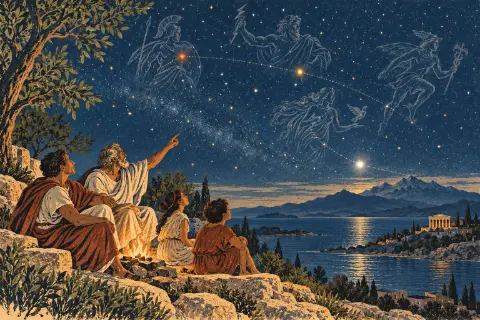 Greek and Roman gods: the names compared
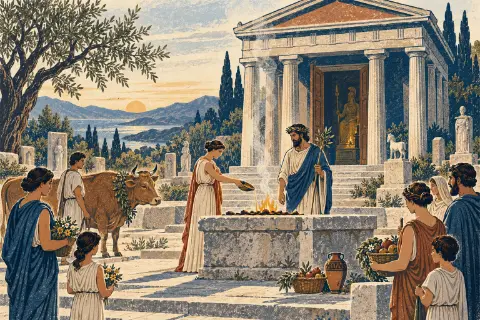 Greek religion: temples, priests and sacrifices
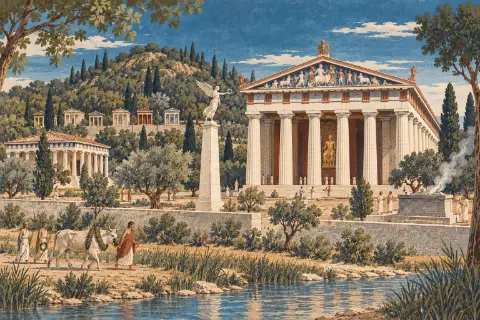 Olympia: the sanctuary of Zeus