
Ctesibius and the water clock
In the 3rd century BC, the city of Alexandria in Egypt was ruled by Greek kings. Scholars and engineers came to work there. One of them was Ctesibius. The Roman writer Vitruvius says that he was the son of a barber. The books of Ctesibius are lost, so we know his work only from later writers.
Ctesibius did not invent the first water clock. In the law courts of Athens, a clay pot with a small hole near the bottom timed each speech: when the water ran out, the speaker had to stop. The Greeks called it a κλεψύδρα, the “water thief”. A pot like this from the 5th century BC is in the Agora Museum in Athens. Ctesibius built a much better clock. Water dripped in at a steady speed, a float rose slowly, and a little figure pointed to the hours.
Vitruvius also says that Ctesibius built the first water organ, and a machine for lifting water up high. Today a pump is called an αντλία in Greek, at a well or at a petrol station.
Test yourself: 4 words from this page
1 / 4
What does this word mean?
Heron and the doors that opened by themselves
Heron also lived in Alexandria, but much later, in the 1st century AD. In one of his books he mentions an eclipse. Experts matched it with an eclipse seen in Alexandria in 62 AD, and that is how we can date him. Heron himself says that he collected the discoveries of older engineers and added his own.
In his book Pneumatica he describes dozens of devices that work with air, water or steam. Here are three of them:
- a vessel for a temple: you dropped in a coin of five drachmas, and a little water for washing flowed out;
- temple doors that opened by themselves when a fire was lit on the altar;
- a metal ball that turned round and round when water boiled under it. It was pushed by steam, in Greek ἀτμός.
Was the spinning ball the first steam engine? Not really. It did no useful work. It was a clever toy that showed the power of steam. Heron also wrote about a small theatre of puppets that moved on their own.
Archimedes: the screw, the lever and the pulley
Archimedes lived in Syracuse, a Greek city in Sicily, from 287 to 212 BC. He was a great mathematician. The historian Diodorus writes that he invented the “Egyptian screw” on a visit to Egypt. It is a large screw inside a tube: when you turn it, water climbs up. Farmers used it to water their fields by the Nile, and miners in Spain used it to get water out of mines. Some historians think that a similar screw was used in Assyria earlier, but others disagree. The Greek word for it is κοχλίας. At first it meant a snail, because a snail shell has a spiral shape.
Archimedes did not invent the lever, the μοχλός, but he explained the rule of how it works. The writer Plutarch tells a famous story. Archimedes said that with enough force he could move any weight. To show it, he sat far away and, with a system of pulleys, τροχαλίες, he pulled a heavy ship towards him with one hand. Plutarch wrote this more than 300 years later, so we cannot be sure about every detail.
History or legend?
Some stories about Greek inventions are legends. In Homer’s Iliad, the god Hephaestus makes tripods with golden wheels. They roll by themselves, αὐτόματοι, to the meeting of the gods and back again. This is a poem, not a real machine, but it shows that the Greeks dreamed of self-moving things very early.
The famous cry εὕρηκα, “I have found it!”, is another story. Vitruvius, writing about 200 years after Archimedes, says that Archimedes jumped out of his bath and ran home shouting it, because he had solved a problem about a gold crown. Nobody knows if it really happened. But Greeks still shout εύρηκα! when they find an answer.
Other things are well documented. The geographer Strabo says that Sostratus of Cnidus built a tall tower on the island of Pharos at Alexandria, to keep sailors safe. The island’s name became the Greek word for every lighthouse: φάρος.
Key dates
- 5th c. BCIn the law courts of Athens, a κλεψύδρα of clay times the speeches.
- 287–212 BCLife of Archimedes in Syracuse, in Sicily.
- 3rd c. BCCtesibius works in Alexandria, and the tower on Pharos is built.
- 1st c. BCVitruvius writes about Ctesibius and tells the “Eureka” story.
- 62 ADAn eclipse seen in Alexandria, which helps us date Heron.
Eight words, then and now
| Ancient Greek | Greek today | Meaning |
|---|---|---|
| water clock; now hourglass | ||
| pump (once: bilge water) | ||
| steam | ||
| screw (first: snail) | ||
| lever | ||
| pulley | ||
| lighthouse | ||
| I have found it! |
 The Antikythera mechanism: an ancient Greek calculator
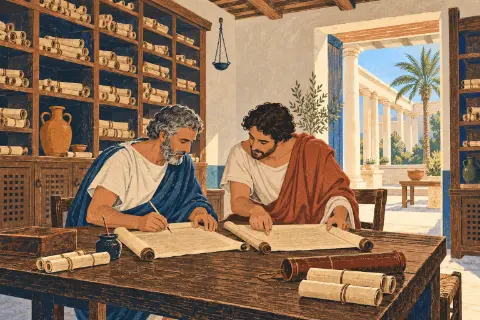 The Library of Alexandria