

Demeter
Δήμητρα
Grain, agriculture and seasonal growth
Demeter governs cultivated grain and the life that depends on it. The Homeric Hymn to Demeter links her grief over Persephone’s disappearance to a pause in the earth’s fertility. That poem also provides a foundation story for the Eleusinian Mysteries, one of the most significant religious traditions of the Greek world.
Mother and daughter
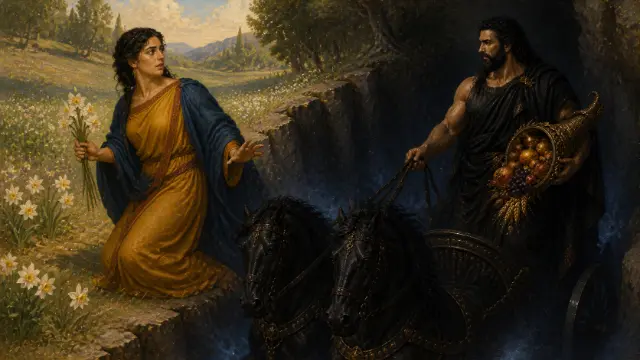
When Hades takes Persephone, Demeter searches with torches and refuses to let crops grow. Zeus arranges her daughter’s return for part of the year, while Persephone must also spend time below. The hymn relates the cycle to seasonal life, but it does not offer a simple scientific explanation of winter; ancient agricultural calendars varied from region to region.
Eleusis and the Mysteries
The hymn places Demeter at Eleusis near Athens. Initiates there took part in rites whose most important details were kept secret. We know of processions, sacred objects and a promise of hope connected with death, but should avoid inventing the undisclosed ceremony. Demeter and Persephone were also worshipped together at other Greek sites.
 Lire le mythe: Persephone and Demeter →
How she was pictured
Stalks of grain, a torch and sometimes a basket help identify Demeter. The large Eleusinian relief shows her with Persephone and Triptolemus, a figure linked to the spread of agriculture. Such artworks show a divine relationship and ritual importance, not only a general idea of harvest.
A living name
Dimitra is a familiar personal name in Modern Greek. The ancient name Δήμητρα survives almost unchanged in spelling, making this goddess an especially direct bridge between ancient texts and present-day Greek. Words around grain, food and seasons open a further route into the language.
Lieux et représentations célèbres
Sanctuaires et œuvres où cette divinité est représentée ou honorée. Les statues perdues et les attributions incertaines sont signalées.
- Sanctuary of Demeter and KoreEleusis, Greece
The central place of the Eleusinian Mysteries.
- Great Eleusinian ReliefNational Archaeological Museum, Athens
Depicts Demeter, Persephone and Triptolemus.
Sources anciennes
Homeric Hymn to Demeter; Hesiod, Theogony 912–914; Pausanias, Description of Greece 1.38.
Pour replacer le culte et les images dans leur contexte, voir le Metropolitan Museum of Art.