

Hades
Άδης
The dead and the underworld
Hades is the ruler of the underworld, not the Greek equivalent of a devil. His name can mean both the god and the realm of the dead. He rarely leaves that realm in surviving stories, which makes the account of Persephone’s abduction especially prominent. Greek ideas about death were varied and changed over time.
A share of the cosmos
The Iliad describes Zeus, Poseidon and Hades drawing lots for sky, sea and the unseen world. Hades’s authority is real, but he is not usually counted among the twelve gods who dwell on Olympus. The underworld contains many figures and regions in Greek literature; it is not one simple chamber of punishment.
Persephone and Demeter
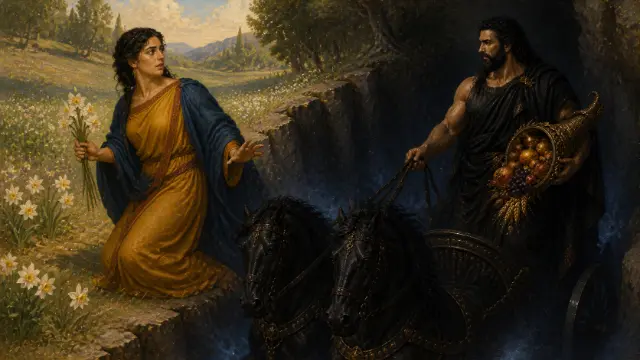
In the Homeric Hymn to Demeter, Hades takes Persephone with Zeus’s consent. Demeter’s grief halts the earth’s fertility until a settlement allows the daughter to return for part of the year. Modern retellings sometimes turn this into a romance, but the source centres the mother’s search, Persephone’s lack of consent and the consequences for the living.
 Lire le mythe: Persephone and the underworld →
Images and places
Hades can be shown enthroned with a sceptre, accompanied by Persephone or the three-headed dog Cerberus. His Roman name Pluto is used for the dramatic seventeenth-century sculpture The Rape of Proserpina in Rome. That work is a later interpretation of the ancient story, not an ancient Greek cult statue.
The word today
Modern Greek still uses Άδης for the mythic underworld. The name appears in literature and expressions about death, while Pluto names a dwarf planet in English and Greek. The older Greek texts provide a more complex picture than the familiar “god of the dead” label suggests.
Lieux et représentations célèbres
Sanctuaires et œuvres où cette divinité est représentée ou honorée. Les statues perdues et les attributions incertaines sont signalées.
- The Rape of ProserpinaGalleria Borghese, Rome, Italy
Bernini’s Baroque sculpture depicts the Roman version of Hades taking Persephone.
- Necromanteion of AcheronEpirus, Greece
A site traditionally linked with approaches to the underworld; its ancient identification is debated.
Sources anciennes
Homer, Iliad 15.187–193; Homeric Hymn to Demeter; Homer, Odyssey 11.
Pour replacer le culte et les images dans leur contexte, voir le Metropolitan Museum of Art.