

Hestia
Εστία
Hearth and the shared household
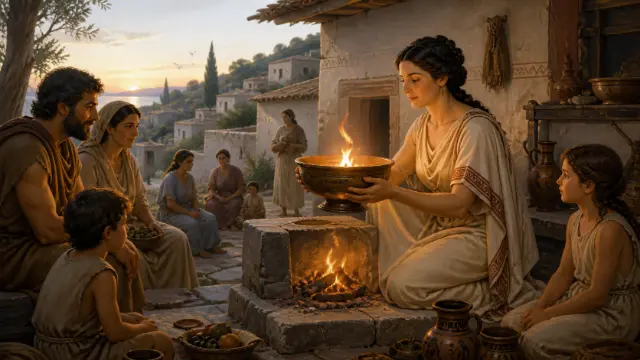
Hestia presides over the hearth, a place of warmth, food and shared life. She has fewer dramatic adventures than many Olympians, but her importance is easy to overlook if mythology is read only as a collection of action stories. Domestic and civic fires brought her into rituals across the Greek world.
A goddess who stays
In the Homeric Hymn to Aphrodite, Hestia refuses marriage and receives honour in the centre of the house. Her steadiness contrasts with gods who roam, fight or disguise themselves. Some later lists of twelve Olympians include her, while others include Dionysus. There was no single official twelve-member roster shared by every ancient author and city.
The household and the city
A family hearth mattered for meals, hospitality and offerings. Greek public buildings also maintained shared hearths, making Hestia relevant to civic identity as well as private homes. At the prytaneion, the civic hearth represented the continuity of the community. This is a kind of divine presence that does not need a large narrative scene to be significant.
 Lire le mythe: Hestia and the hearth →
Finding Hestia in art
Hestia can appear as a modestly dressed or veiled woman, but without an inscription or context her image is hard to distinguish from other goddesses. The lack of a universally famous standalone statue is itself revealing: her primary symbol was the living hearth. The site’s mythology library supplies the same approved appearance whenever she is illustrated.
A word you can still hear
In Modern Greek, εστία still means a hearth or focal point and appears in compounds for restaurants, homes and institutions. Her name is therefore part of ordinary language as well as ancient religion. The Roman Vesta had a different civic history, especially in Rome, and should not simply replace Greek Hestia in an account of Greek practice.
Lieux et représentations célèbres
Sanctuaires et œuvres où cette divinité est représentée ou honorée. Les statues perdues et les attributions incertaines sont signalées.
- Prytaneion at OlympiaOlympia, Greece
A civic hearth illustrates the kind of public fire sacred to Hestia.
- Ancient AgoraAthens, Greece
The civic context of shared hearth rituals; no single securely identified famous statue is required.
Sources anciennes
Homeric Hymn to Aphrodite 21–32; Homeric Hymns to Hestia; Hesiod, Theogony 453–455.
Pour replacer le culte et les images dans leur contexte, voir le Metropolitan Museum of Art.