

Hecate
Εκάτη
Crossroads, thresholds and night
Hecate is a goddess of boundaries: crossroads, doorways and passages between worlds. Her role changes across the sources. Hesiod gives her wide honours in many parts of life; the Homeric Hymn to Demeter makes her a torch-bearing helper in the search for Persephone. Later images add triple bodies and stronger associations with magic.
The early goddess
Hesiod praises Hecate as a powerful deity honoured by Zeus, able to help in assemblies, contests and the keeping of animals. This broad early role can surprise readers who know only a modern “witch goddess”. It is a reminder that a deity’s later reputation should not be projected backwards onto every ancient source.
With Demeter and Persephone
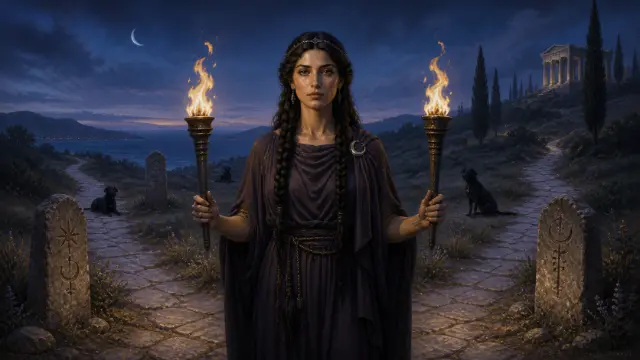
In the Homeric Hymn to Demeter, Hecate hears Persephone’s cry and meets Demeter carrying a torch. After Persephone’s return, she becomes her companion. The story places Hecate near a threshold between life above and below, without making her ruler of the dead. Her torches are therefore more than spooky decoration; they belong to a specific search narrative.
 Lire le mythe: Hecate →
Images at crossroads
Later Greek sculpture sometimes represents Hecate as three female figures joined together, facing different directions. Small statues known as hekataia could stand at entrances and crossroads. The surviving record varies by place and period, so not every torch-bearing figure should be identified as her. The site reuses the exact approved Hecate scene reference from its mythology library.
An evolving figure
Εκάτη remains the Greek name. Modern fantasy often amplifies magic and night, while ancient texts offer a wider set of functions. Comparing Hesiod, the hymn and later art is the clearest way to see how her identity developed rather than treating all depictions as equally old.
Lieux et représentations célèbres
Sanctuaires et œuvres où cette divinité est représentée ou honorée. Les statues perdues et les attributions incertaines sont signalées.
- Hekataia at ancient crossroadsGreek archaeological collections
Small triple-form statues marked entrances and junctions; surviving examples vary.
- Sanctuary of Hecate at LaginaCaria, Türkiye
An important ancient cult site with sculptural remains.
Sources anciennes
Hesiod, Theogony 404–452; Homeric Hymn to Demeter 24–27 and 438–440; Pausanias, Description of Greece 2.30.
Pour replacer le culte et les images dans leur contexte, voir le Metropolitan Museum of Art.