
Greek for Greek-Americans
I understand Greek but can’t speak it: where to start
If you grew up hearing Greek, you learned to understand it, but you rarely had to speak it, so speaking got little practice. It is common and it has a name: receptive, or passive, bilingualism. Start by saying so in Greek, «Καταλαβαίνω αλλά δεν μιλάω καλά» (ka-ta-la-VE-no a-LA then mi-LA-o ka-LA), then learn to read the letters, say fixed phrases aloud, and answer in Greek at home, a little every day.
This page is a taste of the course: Greek written, spoken and practiced, from the alphabet to real conversation. Start free →
The sentences you need first
| In Greek | How it sounds | What it means |
|---|---|---|
| ka-ta-la-VE-no a-LA then mi-LA-o ka-LA | I understand but I don’t speak wellYour opening line. It tells people where you stand. | |
| THE-lo na MA-tho e-li-ni-KA | I want to learn GreekSay it to the family, so they know. | |
| MEE-la moo e-li-ni-KA | Speak Greek to meFor the relative who switches to English to make it easy for you. | |
| pes to pyo ar-GA, se pa-ra-ka-LO | Say it more slowly, pleaseTo one person you know well. To someone older or to several people: «Πείτε το πιο αργά» (PEE-te to pyo ar-GA). | |
| pos to LE-ne af-TO? | What is this called?Point at the thing. A good way to collect words in the kitchen. | |
| pos LE-ye-te sta e-li-ni-KA? | How do you say it in Greek?When the English word is the only one that comes. | |
| ti si-ME-ni? | What does it mean?For a word you have often heard and never asked about. | |
| then ka-TA-la-va | I didn’t understandBetter than nodding. Follow it with «Ξαναπές το». | |
| ksa-na-PES to | Say it againInformal, to family and friends. | |
| so-STA to EE-pa? | Did I say it right?After any sentence you were not sure of. | |
| na me thi-or-THO-nis | Correct me when I’m wrongTells the family you want their help. | |
| mi-LA-o LEE-ga e-li-ni-KA | I speak a little GreekFor people outside the family: at church, at the festival, in Greece. |
From the course
Try it the way the course teaches it
Question 1 of 4. What does it mean?
Καταλαβαίνω αλλά δεν μιλάω καλά
Learn the Greek your family speaks, properly
CHF 129 for all six levels, paid once. No subscription. A free starter course at every level.
One click, no password to create · the free course starts at once
Why you understand but can’t speak

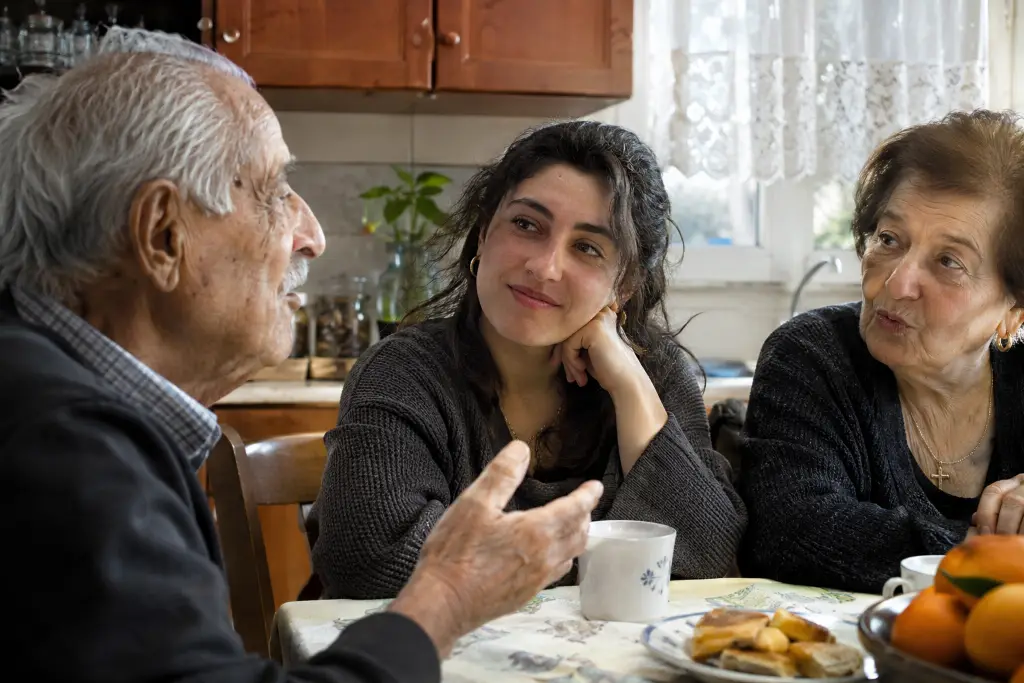
You follow the conversation at the table. You know when your yiayia is pleased and when she is not. Then someone turns to you, and the answer comes out in English. Many people who grew up around Greek know this moment, and it is not a failure.
Understanding and speaking are two separate skills, and each one grows only when it is used. As a child you heard a great deal of Greek. But you rarely had to speak it: the adults understood English, school and friends were in English, and answering in English worked. So one skill grew and the other did not.
Linguists call this receptive or passive bilingualism, and they call a person who grew up with a family language a heritage speaker. It is a common result of growing up with one language at home and another everywhere else. About 1.2 million Americans report Greek ancestry, and only about one in five speaks Greek at home (US Census Bureau). Many of the others grew up hearing it, as you did.
Two more things often come with it. Many people who learned by ear never learned to read Greek. And some were teased as children for a mistake, and found it safer to stay quiet.
What you already have

You are not a beginner, even if you feel like one.
- The sounds. The sounds of Greek are familiar to your ear, including the ones English does not have, such as γ and χ.
- The ear for what is right. When a sentence is wrong you often feel it, even if you cannot say why.
- The words of home. Food, family, feelings, church, scolding and blessing. Words that a textbook teaches late.
- The reason. You are not learning Greek for an exam. You are learning it for particular people.
What is usually missing is narrower than it feels: reading, the words outside the house, and the habit of opening your mouth.
Where to start, in order

- 1. Learn to read the letters. There are 24. Greek is spelled far more regularly than English: once you know the letters and a few letter pairs, you can read a word aloud. Reading turns sounds you already know into words you can look up, write in a message and remember.
- 2. Say fixed phrases aloud. Start with whole sentences you have heard all your life: «Τι κάνεις;», «Χρόνια πολλά», «Καλή όρεξη», and the ones in the list above. Say them out loud, alone at first. Your mouth needs the practice your ears already had.
- 3. Answer in Greek at home. Pick one person and one moment: the phone call with your mother, coffee with your pappou. Answer in Greek there, even with one word. «Ναι», «Καλά», «Ευχαριστώ» all count.
- 4. Keep it short and daily. Ten or fifteen minutes every day is easier to keep up than two hours on a Sunday, and speaking grows with regular use.
- 5. Then fill the gaps on purpose. Once you are talking, you will notice what you lack: verb endings, the past tense, words for work and news. That is the moment for structured lessons. You will not be starting from nothing.
How long it takes depends on how much you heard as a child and how often you speak now. Nobody can honestly give you a number of weeks.
Getting the family on your side
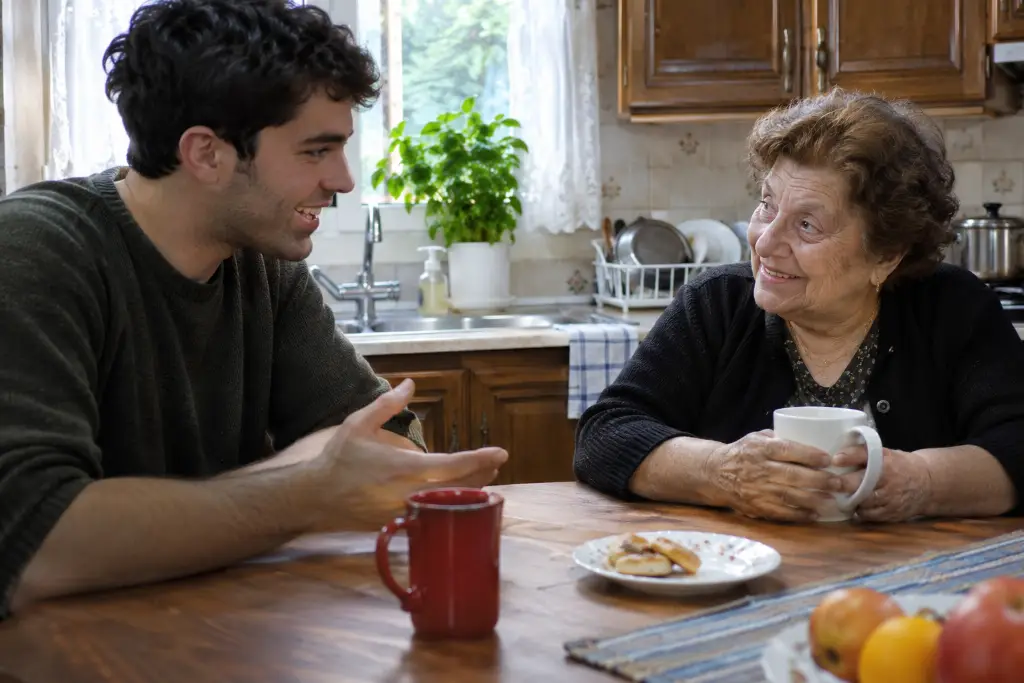
Families often switch to English out of kindness, and then you get no practice. Ask them plainly: «Μίλα μου ελληνικά». Ask them to wait while you look for the word and not to finish your sentence.
Tell them you want to be corrected, «Να με διορθώνεις», and that you would like it done gently.
And accept that you will mix the two languages for a while. A sentence that is half Greek is still Greek spoken aloud.
At your grandmother’s kitchen table
- Youya-YA, THE-lo na MA-tho e-li-ni-KA. MEE-la moo e-li-ni-KA.Grandma, I want to learn Greek. Speak Greek to me.
- YiayiaBRA-vo, pe-THEE moo! ka-ta-la-VE-nis?Good for you, my child! Do you understand?
- Youka-ta-la-VE-no, a-LA then mi-LA-o ka-LA. pes to pyo ar-GA.I understand, but I don’t speak well. Say it more slowly.
- Yiayiasi-GA si-GA. tha ta MA-this.Little by little. You will learn it.
Questions people ask
Why can I understand Greek but not speak it?
Because you practiced one skill and not the other. You heard Greek for years as a child, but English was enough to answer with, so speaking got little practice. Understanding and speaking develop separately, each through use.
I understand Greek but can’t speak it: where do I start?
In this order: learn to read the 24 letters, say fixed phrases aloud, answer in Greek with one person at home, and practice a little every day. Then take lessons that fill the gaps you notice.
What is a heritage speaker?
A heritage speaker is someone who grew up with a family language at home, such as Greek, in a country where another language is spoken. Heritage speakers often understand more than they can say, and many do not read or write the language.
What is a passive bilingual?
A passive, or receptive, bilingual understands a second language but does not speak it comfortably. It is common among the children and grandchildren of immigrants, and it is a starting point, not a defect.
Do I have to start from the beginning, like a complete beginner?
No. You already have the sounds, an ear for what is right and a large home vocabulary. You do need the things you missed: the alphabet, reading, and the grammar you use by feel. Already understanding the language helps with all three.
How do I say “I understand Greek but I can’t speak it” in Greek?
«Καταλαβαίνω ελληνικά αλλά δεν μιλάω καλά» (ka-ta-la-VE-no e-li-ni-KA a-LA then mi-LA-o ka-LA): “I understand Greek but I don’t speak well.”
You can say it. Now learn to read it.
Where are you starting from?
Born abroad, Greek by family: you never have to choose. Start from the Greek you already carry.
- About 1.2 million Americans are of Greek descent. About one in five speaks Greek at home. (US Census Bureau, 2019)
Learn the Greek you grew up hearing: Greek-Americans · Greek-Australians · Greek-Canadians · British Greeks and Cypriots · Deutschgriechen (auf Deutsch) · All Greek Heritage pages