
Greek for Greek-Americans
You speak Greek but can’t read it: the alphabet for people who learned by ear
If you understand Greek, you already own the hard part: the sounds and where the stress falls. Reading is matching 24 letters and a handful of letter pairs to those sounds, so «γιαγιά» (ya-YA) and «καλημέρα» (ka-li-ME-ra) are the best first words, because your ear checks you. Watch for the letters that look English but are not, such as «Η» (ee), «Ρ» (r) and «Χ» (h).
This page is a taste of the course: Greek written, spoken and practiced, from the alphabet to real conversation. Start free →
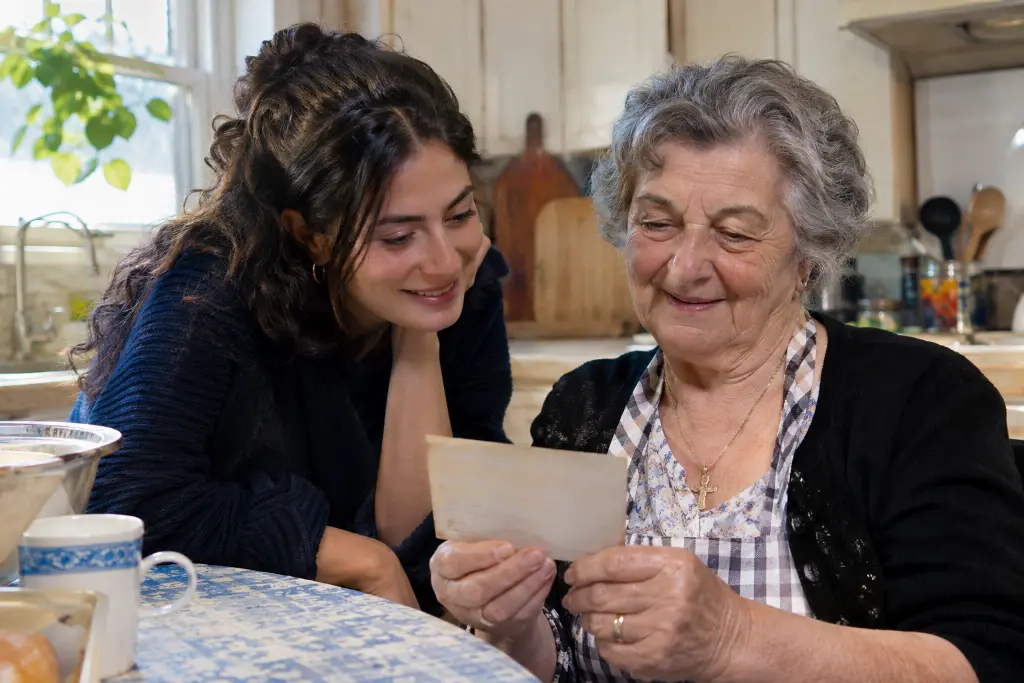
First words to read: you already know how they sound
| In Greek | How it sounds | What it means |
|---|---|---|
| ya-YA | Grandmotherγι together sounds like the y of “yes”. The accent mark on the last ά shows the stress you already hear. | |
| pa-POOS | GrandfatherTwo letters, ο and υ, make one sound: oo. A double π is said as one p. | |
| ka-li-ME-ra | Good morningThe η looks like an English H but sounds like the ee of “see”. The ρ looks like a p but is an r. | |
| ef-ha-ri-STO | Thank youευ is said ef here, before χ, and ev before a vowel or a letter such as β, γ, δ, λ, μ, ν or ρ. The χ is the breathy h you know from «Χριστός». | |
| hri-STOS a-NE-sti | Christ is risenWords you have heard every Easter. The Χ is not an x and never a k: it is a breathy h. | |
| pso-MEE | BreadOne letter, ψ, for the two sounds ps. ω is just another o. | |
| bam-BAS | DadGreek has no single letter for b: it writes μπ, said b at the start of a word and b or mb inside it. The letter β is a v. | |
| do-MA-ta | TomatoSame idea for d: Greek writes ντ, said d at the start of a word. The letter δ is the th of “this”. | |
| FOOR-nos | Oven; the bakeryThe word on the bakery sign. φ is f. The ν looks like a v but is an n. | |
| HRO-nya po-LA | Many years (the wish for name days, birthdays, feasts)A double λ is said as one l. The ι before a vowel glides, so «Χρόνια» has two syllables. | |
| e-LA-tha | GreeceOn a sign in capitals: ΕΛΛΑΔΑ. By spelling convention, words written all in capitals carry no accent marks, so the stress is yours to supply. |
From the course
Try it the way the course teaches it
Question 1 of 4. What does it mean?
γιαγιά
Learn the Greek your family speaks, properly
CHF 129 for all six levels, paid once. No subscription. A free starter course at every level.
One click, no password to create · the free course starts at once
You already know the hard part
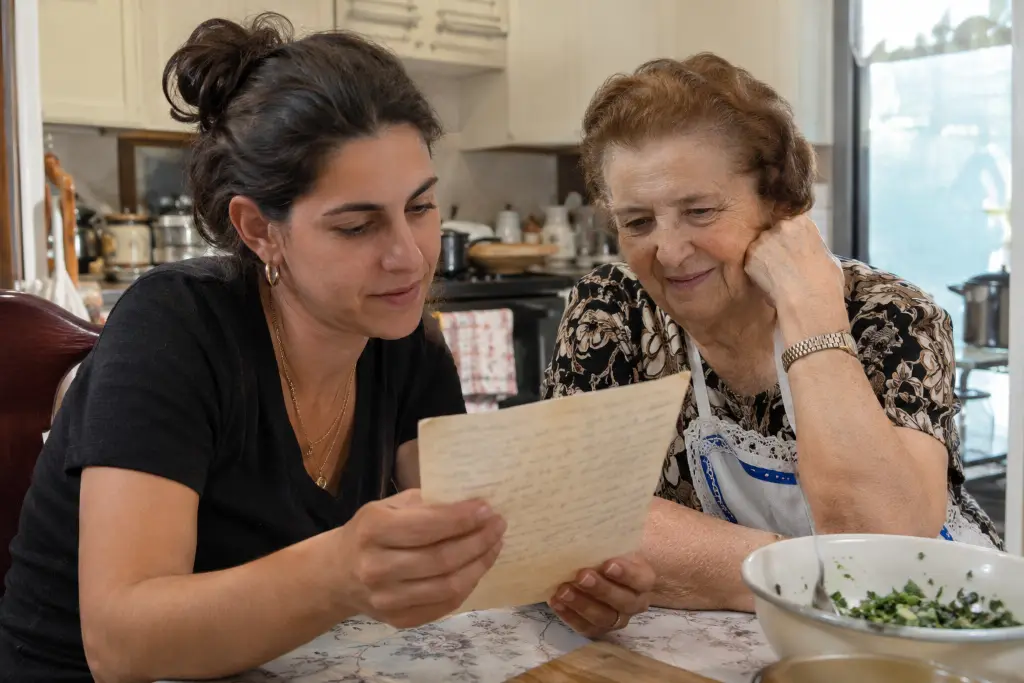
A beginner has to learn the letters, the sounds, the stress and the meaning, all at once. You learned three of those at your yiayia’s table, at church and on the phone with cousins. What is missing is only the link between the sounds you know and the marks on the page.
That makes reading the fastest thing a heritage speaker can learn. When you sound out ψωμί and hear “psomi”, you know at once that you got it right, because the word is already in your head. A beginner has no such check. You do.
The accent mark helps too. In small letters every Greek word of two syllables or more carries one, and it sits on the syllable you already stress: καλημέρα, ευχαριστώ, γιαγιά.
The letters that fool an English reader

Most Greek letters are easy. A few look like English letters and sound like something else. Learn these first and you will avoid most mistakes.
- Η η is ee, not h.
- Ρ ρ is r, not p.
- Ν ν is n. The small one looks like a v.
- Β β is v, not b.
- Χ χ is a breathy h, not x.
- Υ υ is ee, not u or y.
- Δ δ is the th of “this”; Θ θ is the th of “thin”.
- Γ γ is a y before e and ee sounds (γιαγιά), and a soft, throaty g elsewhere (γάλα, milk).
- σ and ς are both s. The second one is used only at the end of a word.
Two letters, one sound
Greek often spells one sound with two letters. Once you know these pairs, whole words open up.
- ου = oo: παππούς, φούρνος.
- αι = e, as in “bet”: και, “and”.
- ει and οι = ee, the same sound as ι, η and υ.
- μπ = b, ντ = d, γκ = g at the start of a word: μπαμπάς, ντομάτα. Inside a word you will often hear mb, nd and ng, and γγ is ng too.
- αυ and ευ = av and ev, or af and ef before sounds like p, t, k, f, th, s and h: αύριο (AV-ri-o), tomorrow; ευχαριστώ.
- τσ = ts and τζ = dz: τσάι, tea.
Five spellings for the one ee sound sounds like trouble, but it is a spelling problem, not a reading problem. When you read, they all say ee. You only need to tell them apart when you write.
Where to start reading
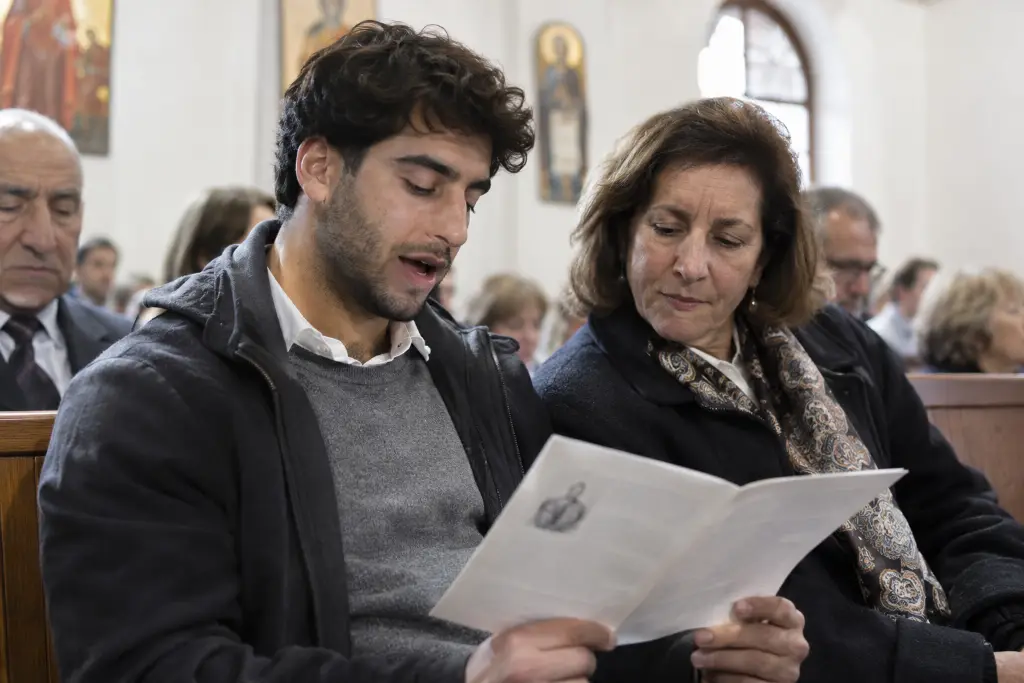
Start with Greek you already have, so your ear can do the checking.
- Your family’s names. Find them in Greek on a baptism certificate or an old letter: Γιώργος, Ελένη, your own surname.
- Church. The words of «Χριστός Ανέστη» and «Κύριε ελέησον» are printed in many service books beside the English.
- The kitchen. Yiayia’s recipe cards, the label on the feta, the box from the Greek bakery.
- Your cousins. Messages from Greece often come in Greek letters. Read them out loud, slowly, before you reach for a translator.
Read aloud, always. Your mouth knows these words better than your eyes do, and saying them is how the two meet.
In the kitchen, with yiayia’s recipe card
- Youya-YA, e-THO GRA-fi ZA-ha-ri?Grandma, does it say “sugar” here?
- Yiayiane, ZA-ha-ri. BRA-vo soo!Yes, sugar. Well done!
- Youke af-TO e-THO GRA-fi ka-NE-la.And this one here says “cinnamon”.
- Yiayiaso-STA! thi-a-VA-zis e-li-ni-KA!Right! You are reading Greek!
Questions people ask
How do I learn to read Greek if I already speak it?
Learn the letters that look English but are not (Η is ee, Ρ is r, Χ is h, Β is v), then the letter pairs (ου is oo, μπ is b, ντ is d). Then read words you already know out loud, such as «γιαγιά» and «καλημέρα». Your ear tells you when you have it right.
Is the Greek alphabet hard to learn?
Not for someone who speaks Greek. There are 24 letters, many of them familiar from math and from English. The sounds are the ones you grew up with; only the shapes are new.
Why do some Greek letters look like English letters but sound different?
The Latin alphabet grew out of the Greek one, and the two drifted apart over many centuries. So Η, Ρ, Ν, Β, Χ and Υ look familiar but are said ee, r, n, v, h and ee in Modern Greek.
How do I know where the stress goes when I read Greek?
Look for the accent mark: «καλημέρα», «ευχαριστώ». In small letters every word of two syllables or more has one. Words written all in capitals leave it out by convention, as on signs, and there your ear supplies it.
Can I just read Greek written in English letters?
You can, and your cousins may text you that way. But there is no fixed system for it, so the same word is spelled many ways: chronia, xronia, hronia. Greek letters have one spelling, and everything printed in Greece uses them.
Is the Modern Greek alphabet the same as Ancient Greek?
The letters are the same. Many “learn to read Greek” books teach the pronunciation scholars use for Ancient Greek, which is not the Greek your family speaks. For Modern Greek, read the letters with the sounds you heard at home.
You can say it. Now learn to read it.
Where are you starting from?
Born abroad, Greek by family: you never have to choose. Start from the Greek you already carry.
- About 1.2 million Americans are of Greek descent. About one in five speaks Greek at home. (US Census Bureau, 2019)
Learn the Greek you grew up hearing: Greek-Americans · Greek-Australians · Greek-Canadians · British Greeks and Cypriots · Deutschgriechen (auf Deutsch) · All Greek Heritage pages