

Athena
Αθηνά
Wisdom, craft and defence of cities
Athena joins practical intelligence to the defence of communities. She helps heroes, protects crafts such as weaving and gives her name to Athens. Her helmet, spear and snake-fringed aegis make her recognisable, but the owl and olive tree also tell a quieter story about the city she protected.
Birth and character
In one famous account Athena emerges armed from Zeus’s head after he swallows Metis. The story links strength to intelligence rather than treating wisdom as an afterthought. In the Odyssey she guides Telemachus and Odysseus, sometimes in disguise. Her advice has limits and purposes: a character supported by Athena is not automatically free of mistakes.
Athens, olive and craft
The contest with Poseidon explains why Athens bears Athena’s name. The olive tree, which gives food, oil and wood, wins in familiar versions. She also presides over weaving, pottery and other skills. At the Panathenaic festival, the city honoured her with procession and a woven robe for her cult image.
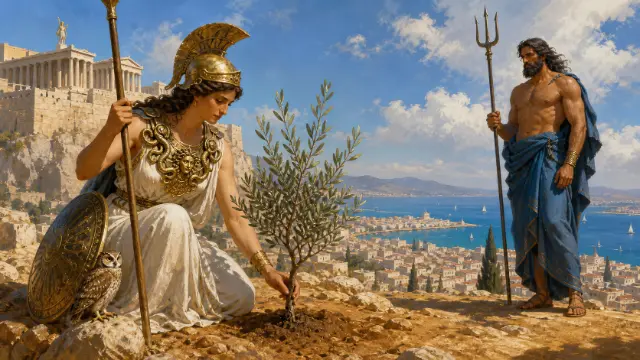 Lire le mythe: Athena and Poseidon →
Statues and sanctuaries
The Parthenon once housed Phidias’s colossal Athena Parthenos, now lost. The smaller Roman-period Varvakeion Athena in Athens helps scholars imagine its appearance. Surviving Acropolis sculpture and vase paintings also show Athena in action. Our mythology gallery keeps her distinctive helmet, aegis, spear and olive-linked setting consistent across stories.
Athena today
Αθηνά remains both the goddess’s name and a Modern Greek form used for the city, Αθήνα. The owl still appears on the Greek one-euro coin, echoing ancient Athenian coinage. Looking at coins, texts and the modern city together makes Athena more than a name in a list of gods.
Lieux et représentations célèbres
Sanctuaires et œuvres où cette divinité est représentée ou honorée. Les statues perdues et les attributions incertaines sont signalées.
- Parthenon and AcropolisAthens, Greece
The lost Athena Parthenos stood within the Parthenon.
- Varvakeion AthenaNational Archaeological Museum, Athens
A small ancient copy of the famous cult statue’s type.
Sources anciennes
Hesiod, Theogony 886–900; Homer, Odyssey 1 and 13; Pausanias, Description of Greece 1.24.
Pour replacer le culte et les images dans leur contexte, voir le Metropolitan Museum of Art.