
Greek for Greek-Americans
Na sas zisi: what it means, how to write it in Greek, and when to say it
«Να σας ζήσει» (na sas ZEE-si) means “may he or she live for you”. Greeks say it to parents and grandparents about a child: at a birth, at a baptism, on the child’s birthday. In Greek letters it is three words, Να σας ζήσει, and the answer is «Ευχαριστούμε» (ef-ha-ri-STOO-me), “we thank you”.
This page is a taste of the course: Greek written, spoken and practiced, from the alphabet to real conversation. Start free →

One wish, and its family
| In Greek | How it sounds | What it means |
|---|---|---|
| na sas ZEE-si | May your child live a long life (literally: may he or she live for you)To both parents, to grandparents, or politely to one person. About one child. | |
| na soo ZEE-si | The same wish, to one personTo one person you know well: a cousin, a friend, your sister. | |
| na mas ZEE-si | May our child live a long lifeWhat the family says about its own child. A grandmother says it about her grandchild. | |
| na sas ZEE-soon | May they live long lives (about two or more)About more than one: twins, or the bride and groom, said to their parents. | |
| na ZEE-se-te | Long life to you bothTo the couple themselves, at a wedding or an engagement. | |
| na ZEE-sis | Long life to youTo the person whose day it is, on a birthday or a name day. | |
| na ton HE-re-ste | May he bring you joyOften follows «Να σας ζήσει». For a girl: «Να τη χαίρεστε» (na ti HE-re-ste). | |
| na sas ZEE-si i mi-KREE | May your little girl live a long lifeWith a word for the child added: “the little one”. For a boy: «Να σας ζήσει ο μικρός» (o mi-KROS). | |
| ef-ha-ri-STOO-me | Thank you (from two or more people)The reply. One person says «Ευχαριστώ» (ef-ha-ri-STO). | |
| na EE-ste ka-LA | May you be wellA warmer reply, to someone older or to several people. |
From the course
Try it the way the course teaches it
Question 1 of 4. What does it mean?
Να σας ζήσει
Learn the Greek your family speaks, properly
CHF 129 for all six levels, paid once. No subscription. A free starter course at every level.
One click, no password to create · the free course starts at once
What the three words mean

You may have heard it at every baptism since you were small. Here it is, word by word.
- να (na): “may”. It turns the verb into a wish.
- σας (sas): “for you”, to more than one person, or to one person politely.
- ζήσει (ZEE-si): “live”, in the form for “he” or “she”, from the verb ζω (zo), “I live”.
Together: “may he or she live, for you”. The child is the one who should live long, and the parents are the ones who receive the wish. The Greek verb does not say “he” or “she”, so the same words work for a boy and for a girl.
How to write it in Greek, and the Latin spellings
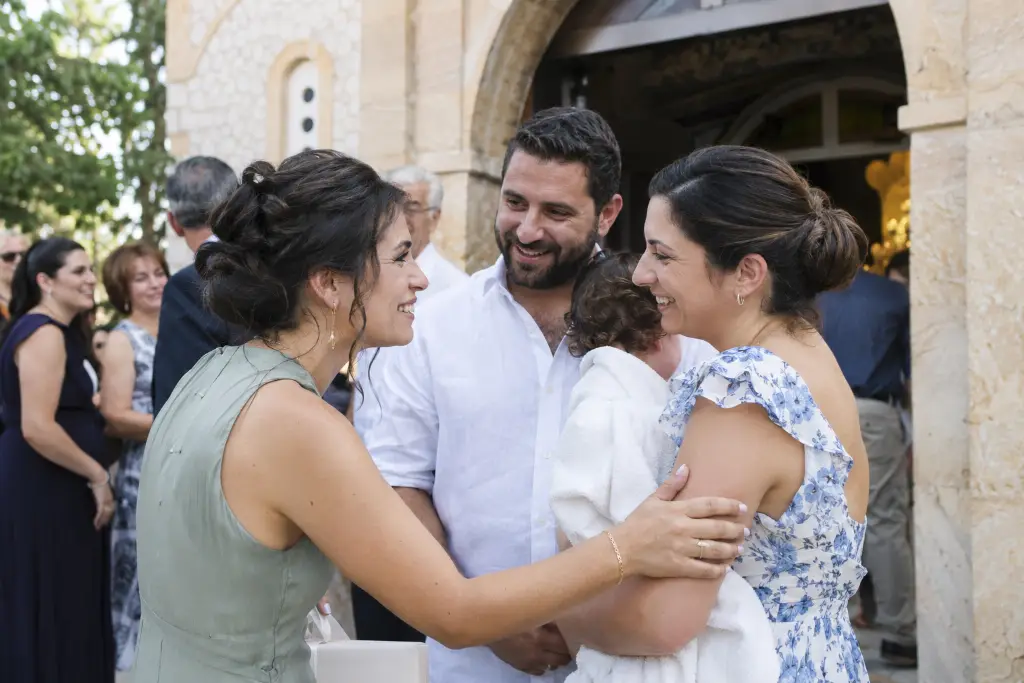
In Greek letters: Να σας ζήσει. The last word has an accent on the ή and ends in ει.
Greek has several ways to write the sound “ee”, and that is why the Latin spellings never agree. You will see na sas zisi, na sas zisei, na sas zhsei and na sas zeesee. In text messages, Greeks often type “h” for the letter η, which gives zhsei. All of them stand for the same three Greek words.
On an old card from a grandparent you may find «Να σας ζήση». That is the older spelling of the same word, with η at the end.
Na sas zisi, na sou zisi, na zisete: which is which

Two small changes carry all the meaning: who you are speaking to, and who should live long.
- «Να σας ζήσει»: about a child, to the parents together.
- «Να σου ζήσει»: about a child, to one parent you know well.
- «Να σας ζήσουν»: about two or more, to their parents. At a wedding it is said to the mother and father of the bride and of the groom.
- «Να ζήσετε»: no σας. It is said straight to the couple: “may you live”.
- «Να ζήσεις»: straight to one person on their birthday or name day. The Greek birthday song begins with these two words.
So at a wedding you turn to the couple with «Να ζήσετε», and to their parents with «Να σας ζήσουν».
When you will hear it, and what to answer
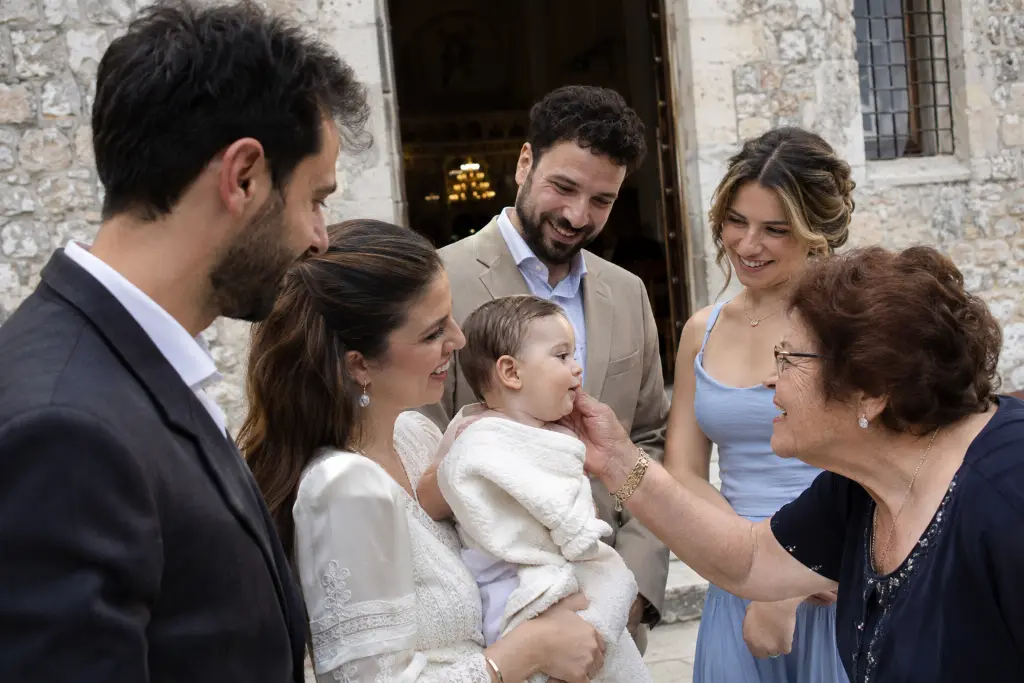
«Να σας ζήσει» belongs to the happy days of a child’s life.
- When a baby is born, to the parents and the grandparents.
- At the baptism, to the parents and the godparents.
- On the child’s birthday or name day, to the parents.
If it is said to you, answer «Ευχαριστούμε», “we thank you”, or «Να είστε καλά», “may you be well”. That is all anyone expects.
At coffee hour, news of a grandchild
- FriendE-ma-tha ta NE-a! na sas ZEE-si o e-go-NOS.I heard the news! May your grandson live a long life.
- Grandmotheref-ha-ri-STOO-me! na EE-ste ka-LA.Thank you! May you be well.
- Friendpos ton LE-ne?What is his name?
- Grandmotherni-KO-la, O-pos ton pa-POO too.Nikolas, like his grandfather.
Questions people ask
What does na sas zisi mean?
It means “may he or she live for you”. It is «Να σας ζήσει» in Greek, a wish for a child’s long life, said to the parents or grandparents at a birth, a baptism or a birthday.
How do you write na sas zisi in Greek?
Να σας ζήσει. Three words, with an accent on the ή of the last one, which ends in ει. Older cards sometimes show ζήση, the earlier spelling.
What is the difference between na sas zisei and na zisete?
«Να σας ζήσει» is about someone else, a child, and is said to the parents. «Να ζήσετε» (na ZEE-se-te) means “may you live” and is said directly to a couple at their wedding or engagement.
Is it na sas zisi or na sou zisi?
Both are correct. «Να σας ζήσει» is for two people, or for one person you address politely. «Να σου ζήσει» (na soo ZEE-si) is for one person you know well.
How do you reply to na sas zisi?
Say «Ευχαριστούμε» (ef-ha-ri-STOO-me), “we thank you”, or «Ευχαριστώ» if you are answering alone. «Να είστε καλά» (na EE-ste ka-LA), “may you be well”, is a warm addition.
How do you pronounce na sas zisi?
na sas ZEE-si. The stress is on ZEE. The final sound is a short “i”, as in “see” but lighter.
You can say it. Now learn to read it.
Where are you starting from?
Born abroad, Greek by family: you never have to choose. Start from the Greek you already carry.
- About 1.2 million Americans are of Greek descent. About one in five speaks Greek at home. (US Census Bureau, 2019)
Learn the Greek you grew up hearing: Greek-Americans · Greek-Australians · Greek-Canadians · British Greeks and Cypriots · Deutschgriechen (auf Deutsch) · All Greek Heritage pages