

Apollo
Απόλλων / Απόλλωνας
Prophecy, music, healing and archery
Apollo is a god of many connections: music, prophecy, archery, healing and disease. The oracle at Delphi made him important to communities seeking advice; the lyre made him a model of measured performance. He was not simply “the sun god” in the earliest Greek sources: Helios is a distinct deity there, even though later traditions bring them together.
Delphi and prophecy
At Delphi the Pythia delivered oracles in Apollo’s sanctuary. Consultations could concern war, colonisation or local decisions, and later writers often presented the answers as ambiguous. The myth of Apollo and Python gives the site a dramatic origin; it should be read alongside the real history of the sanctuary, not in place of it.
Music, healing and danger
Apollo’s lyre associates him with song and the Muses. His arrows can bring sudden illness, as in the opening of the Iliad, while his healing aspect is connected with Asclepius. Greek gods need not have only one function or be harmless because they are revered. The Homeric Hymn to Apollo presents his arrival at Delos and Delphi as two key settings.
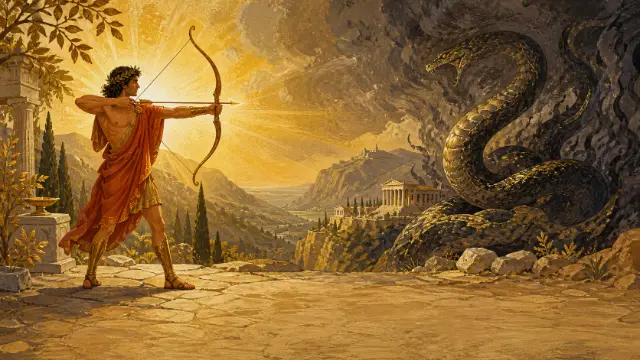 Lire le mythe: Apollo and Python →
The visible god
The laurel became associated with Apollo, especially through the Daphne story. Ancient and later art often shows a youthful figure with a lyre or bow. The Apollo Belvedere, a Roman marble copy in the Vatican Museums, became one of Europe’s most copied classical statues, though it is much later than the earliest Greek cults.
From ancient to modern
Modern Greek commonly says Απόλλωνας; classical texts use Ἀπόλλων. The name continues in Greek places, arts organisations and space exploration. Comparing those forms, and distinguishing Apollo from Helios, makes the ancient evidence clearer.
Lieux et représentations célèbres
Sanctuaires et œuvres où cette divinité est représentée ou honorée. Les statues perdues et les attributions incertaines sont signalées.
- Sanctuary of Apollo at DelphiDelphi, Greece
Home of the Pythia and the Delphic oracle.
- Apollo BelvedereVatican Museums, Vatican City
A Roman marble version of a celebrated Greek sculptural type.
Sources anciennes
Homeric Hymn to Apollo; Homer, Iliad 1; Pausanias, Description of Greece 10.5–10.
Pour replacer le culte et les images dans leur contexte, voir le Metropolitan Museum of Art.