

Aphrodite
Αφροδίτη
Love, desire and beauty
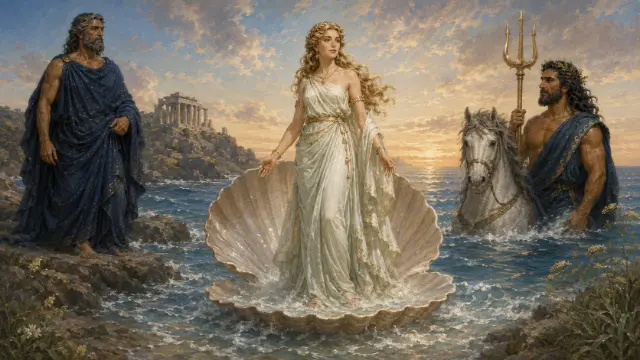
Aphrodite’s power is attraction: not only romantic love, but the force that draws people together and changes their choices. Her birth is told in more than one way. The sea-foam story belongs to Hesiod; Homer gives her different parents. Both versions mattered to later artists and readers.
Birth and rival versions
In the Theogony, Aphrodite rises from the sea near Cyprus after a violent cosmic episode. In the Iliad she is the daughter of Zeus and Dione and is injured while protecting her son Aeneas. A careful reading does not force these accounts into one family tree. Greek myth is a set of traditions, not a single official biography.
Desire in myth
Aphrodite plays a part in the story of Paris and Helen, helping to set the Trojan War in motion. Her relationship with Ares becomes the subject of a witty song in the Odyssey. Eros may accompany her in art and poetry, but his origins also vary between sources. Her influence can be joyous or disruptive, depending on the story and the people caught in it.
 Lire le mythe: Birth of Aphrodite →
Worship and art
Cyprus was particularly important to Aphrodite’s worship. Sculptors later explored many ways of representing her, including the famous Venus de Milo, a Hellenistic statue now in Paris. The statue’s missing arms make its original gesture uncertain. Our mythology portrait uses the site’s canonical reference rather than copying a later marble type into every narrative.
The name today
Αφροδίτη is still used as a personal name in Greek and as the Greek name of the planet Venus. Aphrodisiac derives from the goddess’s name. These continuities keep a link between ancient story, later European art and modern language.
Lieux et représentations célèbres
Sanctuaires et œuvres où cette divinité est représentée ou honorée. Les statues perdues et les attributions incertaines sont signalées.
- Venus de MiloLouvre Museum, Paris, France
A celebrated Hellenistic image of Aphrodite.
- Sanctuary of AphroditePalaepaphos, Cyprus
A major ancient cult centre associated with the goddess.
Sources anciennes
Hesiod, Theogony 188–206; Homer, Iliad 5; Homer, Odyssey 8.266–366.
Pour replacer le culte et les images dans leur contexte, voir le Metropolitan Museum of Art.