
Greek for Greek-Americans
Christos Anesti: how to answer, and every Greek Easter greeting
When someone says «Χριστός Ανέστη» (hri-STOS a-NE-sti), “Christ is risen”, you answer «Αληθώς Ανέστη» (a-li-THOS a-NE-sti), “truly he is risen”. Some people answer with the shorter «Αληθώς ο Κύριος» (a-li-THOS o KEE-ri-os), “truly the Lord is risen”. The exchange starts at the midnight Resurrection service and remains the Easter greeting for forty days, until the eve of the Ascension.
This page is a taste of the course: Greek written, spoken and practiced, from the alphabet to real conversation. Start free →
The greeting, the answers, and the words around them
| In Greek | How it sounds | What it means |
|---|---|---|
| hri-STOS a-NE-sti | Christ is risenThe greeting, from the midnight service on Easter night onward. Whoever speaks first says it. | |
| a-li-THOS a-NE-sti | Truly he is risenThe answer. If you learn one Easter phrase, learn this one. | |
| a-li-THOS o KEE-ri-os | Truly the Lord is risenA shorter answer, heard less often than «Αληθώς Ανέστη». Both are used. | |
| HRO-nya po-LA | Many yearsOften said right after the exchange, with a kiss on both cheeks. The answer is «Χρόνια πολλά» again. | |
| e-PEE-sis | Likewise, you tooThe answer to a wish such as «Καλή Ανάσταση». Not an answer to «Χριστός Ανέστη». | |
| ka-LEE a-NA-sta-si | A good ResurrectionThe wish before the midnight service. After midnight it gives way to «Χριστός Ανέστη». | |
| i a-NA-sta-si | The ResurrectionAlso the name of the midnight service: «πάμε στην Ανάσταση», we are going to the Resurrection service. | |
| to PA-sha | EasterWritten Pascha or Pasha in English. In everyday speech it is also «η Λαμπρή» (i lam-BREE), from the word for “bright”. | |
| ta KO-ki-na av-GA | The red eggsCracked against each other at the Easter table, with «Χριστός Ανέστη» and «Αληθώς Ανέστη». |
From the course
Try it the way the course teaches it
Question 1 of 4. What does it mean?
Χριστός Ανέστη
Learn the Greek your family speaks, properly
CHF 129 for all six levels, paid once. No subscription. A free starter course at every level.
One click, no password to create · the free course starts at once
What the words mean
«Χριστός Ανέστη» means “Christ is risen”. «Αληθώς Ανέστη» means “truly he is risen”. The first person announces the news, and the second confirms it. That is the whole exchange, and you will hear it in Greek churches and Greek homes, in Greece and in America.
Both phrases are church Greek, an older form of the language kept unchanged in the service. They are fixed expressions, so say them exactly as they are.
- ανέστη is an ancient past form of the verb “to rise”. In everyday Greek you would say αναστήθηκε (a-na-STEE-thi-ke), but nobody uses that word in the greeting.
- αληθώς is a learned word for “truly”. The everyday word is αληθινά (a-li-thi-NA). Again, the greeting keeps the old form.
- «Αληθώς ο Κύριος» leaves out the verb: “truly, the Lord”, meaning “truly the Lord is risen”.
When it starts, how it is said, and how long it lasts

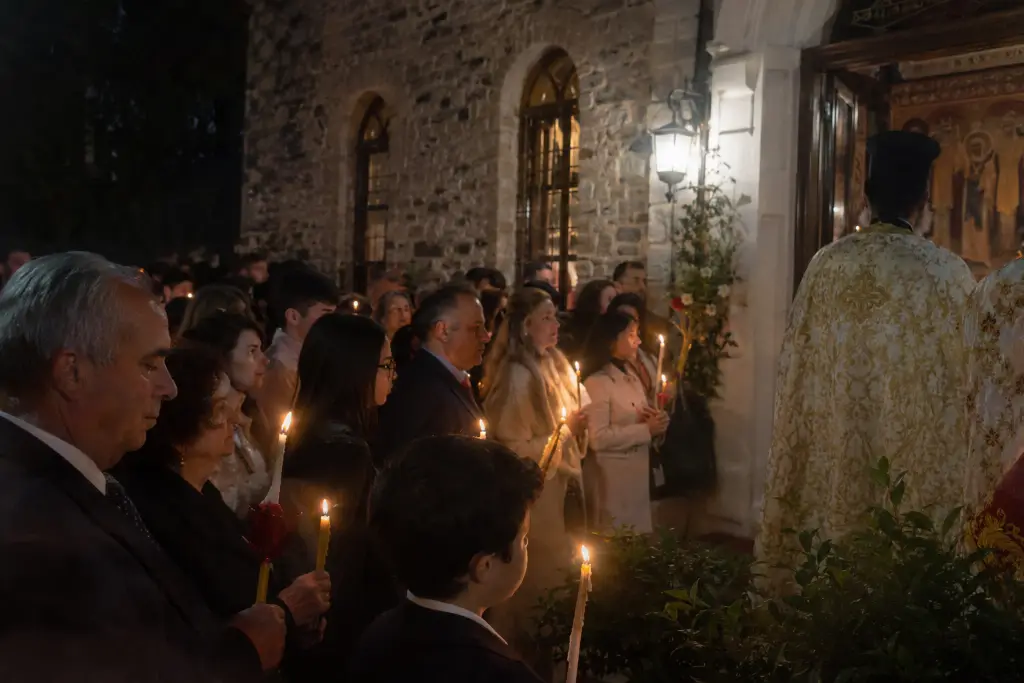
The greeting begins at the Resurrection service, late on Holy Saturday night. Just before midnight the lights go out, and the light is passed from the priest’s candle to everyone’s candle. At midnight the priest sings «Χριστός ανέστη», and the church answers him.
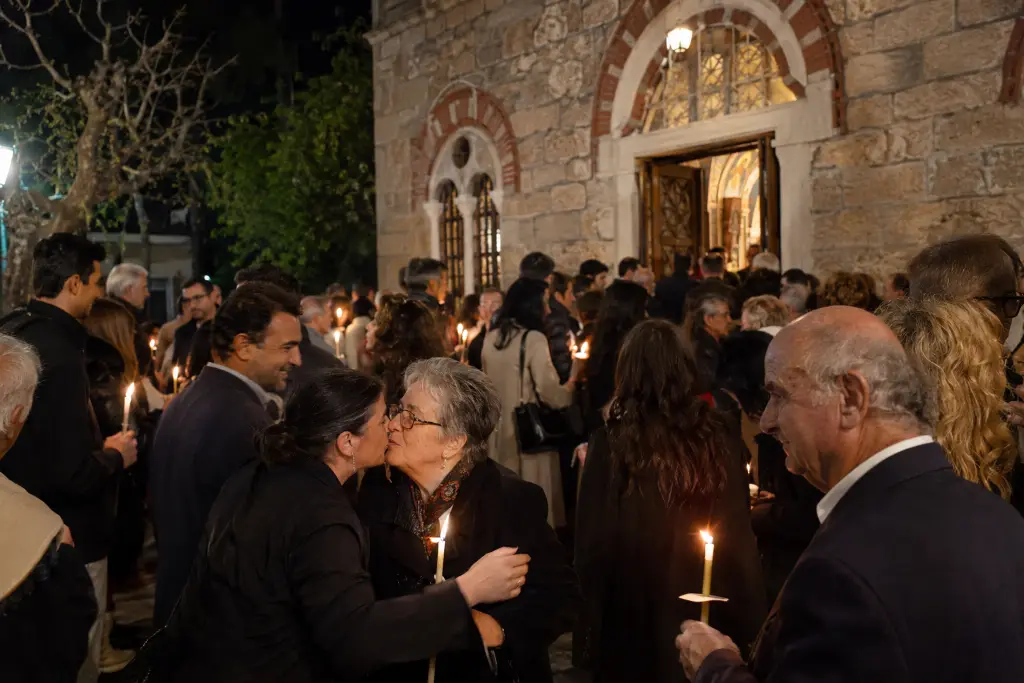
Then people turn to each other. You say «Χριστός Ανέστη» to the person next to you, they answer «Αληθώς Ανέστη», and family and friends often kiss on both cheeks. «Χρόνια πολλά» often follows. Either person may speak first.
At the table the same words come back. Each person takes a red egg and taps it against another’s. The one who taps says «Χριστός Ανέστη», the other answers «Αληθώς Ανέστη». This is το τσούγκρισμα (to TSOON-gri-zma), the egg cracking.
The greeting belongs to the forty days after Easter, until the eve of the Ascension, the day called Απόδοση του Πάσχα (a-PO-tho-si too PA-sha), the leave-taking of Easter. In church and among family it often takes the place of “hello” in that time. How long people keep it up in daily life varies, but if someone greets you with it, the answer is always «Αληθώς Ανέστη».
The spellings you have seen

In Latin letters the greeting is written many ways: Christos Anesti, Xristos Anesti, Hristos Anesti, Cristos Anesti. The answer appears as Alithos Anesti or Alethos Anesti, and the short answer as Alithos o Kyrios. Each set is one Greek phrase.
- The Χ of Χριστός is not an English x or k. It is a breathy h, made at the back of the mouth.
- The stress falls on the last syllable of Χριστός and of αληθώς, and on the middle of ανέστη: hri-STOS a-NE-sti.
- The θ of αληθώς is the th of “think”.
Before midnight: Kali Anastasi

Until the Resurrection service, the wish is not yet «Χριστός Ανέστη». People wish each other «Καλή Ανάσταση» (ka-LEE a-NA-sta-si), “a good Resurrection”, and the answer is «Επίσης», “you too”, or the same wish back. Once the priest has sung «Χριστός ανέστη» at midnight, the greeting changes.
The other wishes of Lent, Holy Week and Easter week, day by day, are on their own page.
Outside the church, just after midnight
- Youhri-STOS a-NE-sti, ya-YA!Christ is risen, Grandma!
- Yiayiaa-li-THOS a-NE-sti, pe-THEE moo! HRO-nya po-LA.Truly he is risen, my child! Many years.
- YouHRO-nya po-LA! hri-STOS a-NE-sti, pa-POO.Many years! Christ is risen, Grandpa.
- Pappoua-li-THOS o KEE-ri-os!Truly the Lord is risen!
Questions people ask
What is the response to Christos Anesti?
«Αληθώς Ανέστη» (a-li-THOS a-NE-sti), “truly he is risen”. Some people answer «Αληθώς ο Κύριος» (a-li-THOS o KEE-ri-os), “truly the Lord is risen”. Both are used.
How do you respond to Christos Anesti?
Say «Αληθώς Ανέστη», and if you are with family, kiss on both cheeks and add «Χρόνια πολλά» (HRO-nya po-LA), “many years”. Do not answer «Επίσης»: that is the reply to a wish, not to this greeting.
What does Alithos Anesti mean?
“Truly he is risen.” «Αληθώς» is a church word for “truly”, and «ανέστη» an old form of “he rose”. It is also spelled Alethos Anesti.
What does Christos Anesti mean?
“Christ is risen.” It is the Easter greeting of the Greek Orthodox Church, also written Xristos Anesti or Hristos Anesti in Latin letters.
How long do you say Christos Anesti?
From the midnight Resurrection service for forty days, until the eve of the Ascension (the Απόδοση του Πάσχα, the leave-taking of Easter). How long people use it in daily life varies; if someone says it to you in that time, answer «Αληθώς Ανέστη».
When do you stop saying Kali Anastasi and start saying Christos Anesti?
At midnight, at the Resurrection service. «Καλή Ανάσταση» is a wish for the service ahead, so it stops once the priest has sung «Χριστός ανέστη».
You can say it. Now learn to read it.
Where are you starting from?
Born abroad, Greek by family: you never have to choose. Start from the Greek you already carry.
- About 1.2 million Americans are of Greek descent. About one in five speaks Greek at home. (US Census Bureau, 2019)
Learn the Greek you grew up hearing: Greek-Americans · Greek-Australians · Greek-Canadians · British Greeks and Cypriots · Deutschgriechen (auf Deutsch) · All Greek Heritage pages