

In English, “I like coffee” and “I like films” use the same verb form. Greek changes the form in these examples: μου αρέσει ο καφές, but μου αρέσουν οι ταινίες. Look at the thing being liked before choosing the ending. This worksheet practises that choice rather than a full conjugation table.
Compare the four sentences
| Μου αρέσει ο καφές. | I like coffee. |
| Μου αρέσουν οι ταινίες. | I like films. |
| Σου αρέσει αυτό το βιβλίο; | Do you like this book? |
| Σου αρέσουν αυτά τα βιβλία; | Do you like these books? |
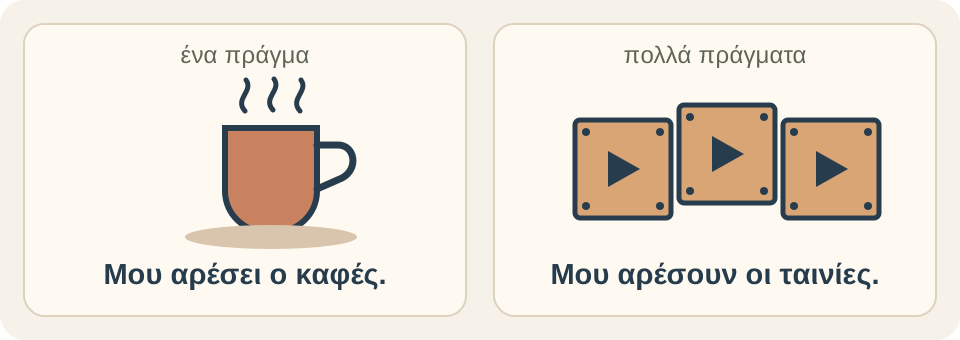
Find the thing being liked
Ο καφές is singular, so the example uses αρέσει. Οι ταινίες is plural, so it uses αρέσουν. The thing being liked functions as the subject of this Greek construction. The person expressing the preference is marked by μου, “to me”, or σου, “to you”. Do not choose αρέσουν merely because more than one person is speaking.
Change the person separately
Μου αρέσει αυτό το βιβλίο means “I like this book”. Σου αρέσει αυτό το βιβλίο; asks “Do you like this book?”. Changing μου to σου changes whose preference you ask about; the singular book still takes αρέσει. In the last row, αυτά τα βιβλία is plural, which explains αρέσουν.
Add a negative or an activity
Δεν μου αρέσει ο καφές means “I do not like coffee”. Δεν μου αρέσουν οι ταινίες means “I do not like films”. Keep the same singular/plural distinction when adding δεν. To name an activity, use Μου αρέσει να διαβάζω, “I like reading”. That sentence has a να-clause, not a plural noun requiring αρέσουν.
Choose the form
- Μου ___ ο καφές. Choose αρέσει or αρέσουν.
- Μου ___ οι ταινίες. Choose αρέσει or αρέσουν.
- Σου ___ αυτό το βιβλίο; Choose αρέσει or αρέσουν.
- Does changing μου to σου make the word βιβλίο plural?
Show the answers
1. αρέσει: ο καφές is singular. 2. αρέσουν: οι ταινίες is plural. 3. αρέσει: αυτό το βιβλίο is singular. 4. No: it changes the person whose preference is expressed.
Build a pair of your own
Start with Μου αρέσει αυτό το βιβλίο. Replace αυτό το βιβλίο with αυτά τα βιβλία and change the verb accordingly. Read the two versions aloud, then turn them into questions with σου. Check the noun phrase before checking your answer against the table.
Other ways to talk about what you like
Once the singular/plural choice is clear, these variants add strength, emphasis or another person:
- Μου αρέσει πάρα πολύ η μουσική. — I really love music (stronger).
- Εμένα μου αρέσουν οι ταινίες. — I like films (with emphasis on “me”).
- Σας αρέσει το βιβλίο; — Do you like the book? (polite or plural)
- Του αρέσει το ποδόσφαιρο. — He likes football.
- Της αρέσουν τα ζώα. — She likes animals.
- Λατρεύω τη θάλασσα. — I adore the sea (a separate verb, used like “love”).
- Δεν μου αρέσει καθόλου. — I don’t like it at all.
Common mistakes
- Εγώ αρέσω τον καφέ. → Μου αρέσει ο καφές.: copying the English pattern. In Greek the thing you like is the subject and you are μου.
- Μου αρέσει οι ταινίες. → Μου αρέσουν οι ταινίες.: οι ταινίες is plural, so the verb must be αρέσουν.
- Μου αρέσουν να διαβάζω. → Μου αρέσει να διαβάζω.: an activity with να always takes the singular αρέσει.
Questions about μου αρέσει
How do you say “I like” in Greek? Μου αρέσει for one thing or an activity, μου αρέσουν for several things.
How do you say “Do you like…?” in Greek? Σου αρέσει…; to a friend, Σας αρέσει…; to be polite or to ask several people. Use αρέσουν if the thing is plural.
How do you say “I don’t like” in Greek? Put δεν first: Δεν μου αρέσει or Δεν μου αρέσουν. For “not at all”, add καθόλου.
Use the pattern in a conversation about hobbies or practise inviting someone for coffee.