

Persephone
Περσεφόνη
Underworld, return and renewal
Persephone belongs to two worlds. She is Demeter’s daughter, sought across the earth, and the queen who spends part of the year among the dead. The best-known ancient account makes her abduction central, while cult at Eleusis honours her together with Demeter as “the two goddesses”.
The story of the return
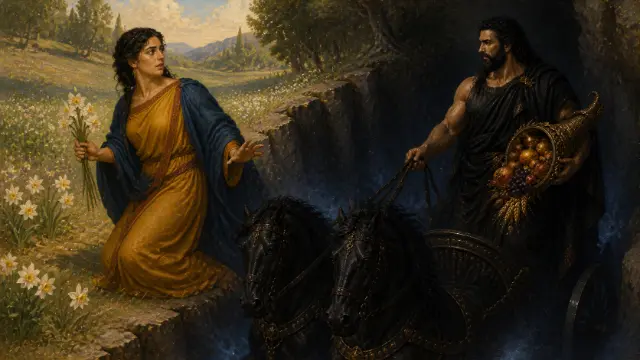
The Homeric Hymn to Demeter calls her Kore, “the maiden”. Hades seizes her; Demeter searches; famine threatens mortals. Persephone’s eating of pomegranate seeds becomes part of the settlement governing her time below and above. Versions differ in the division of the year. The story’s emotional centre is the forced separation and a mother’s refusal to accept it silently.
Queen of the dead
Persephone is not merely a passive seasonal symbol. In the Odyssey she is an awe-inspiring underworld queen, and later Greek traditions give her powers over the fate of the dead. At Eleusis she shared worship with Demeter in the Mysteries. Because initiates kept the central rites secret, confident modern reconstructions should be treated cautiously.
 Διαβάστε τον μύθο: Persephone →
Art and sacred places
Torches, flowers and pomegranate imagery can help identify Persephone, especially beside Demeter or Hades. The Great Eleusinian Relief shows the two goddesses with Triptolemus. Bernini’s sculpture in Rome depicts her Roman counterpart Proserpina being taken by Pluto; its beauty does not erase the violence of the subject.
A name across time
Περσεφόνη remains the Modern Greek spelling of her name. Kore, κόρη, is still an everyday word for daughter or young woman. Reading that word in its ordinary sense and as a divine title helps explain why the Eleusinian pair mattered to Greek families.
Τόποι και γνωστές παραστάσεις
Ιερά και έργα τέχνης όπου τιμήθηκε ή απεικονίστηκε η θεότητα. Σημειώνονται τα χαμένα αγάλματα και οι αβέβαιες ταυτίσεις.
- Great Eleusinian ReliefNational Archaeological Museum, Athens
Persephone stands with Demeter and Triptolemus.
- The Rape of ProserpinaGalleria Borghese, Rome, Italy
A later sculpture of the Roman version of her abduction.
Αρχαίες πηγές
Homeric Hymn to Demeter; Homer, Odyssey 11; Pausanias, Description of Greece 1.38.
Για το ιστορικό πλαίσιο της λατρείας και της τέχνης, δείτε το Metropolitan Museum of Art.