

Dionysus
Διόνυσος
Wine, theatre and transformation
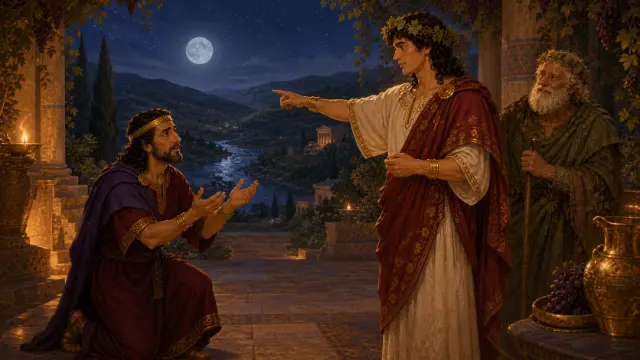
Dionysus brings wine, altered states and theatre into Greek myth and worship. He can be welcomed with festival or resisted with devastating results. His stories move between city and mountain, order and release. The scene used here is one of the character library’s approved references for Dionysus; it preserves the same face used in our Midas story.
A complicated arrival
In a familiar story, Semele dies after asking to see Zeus in his full power, and Dionysus is born again from Zeus’s thigh. The “twice-born” story is one of several ways Greeks spoke of the god’s unusual status. Euripides’s Bacchae presents Dionysus returning to Thebes and confronting King Pentheus, who denies the god’s authority.
Festivals and theatre
Athens held festivals for Dionysus, including the City Dionysia, where tragedies and comedies were performed. This makes him central to the history of drama, not simply a god of drinking. The theatre was a public, religious and civic setting. Masks and choruses belonged to a ritual world whose purposes were richer than entertainment alone.
 Διαβάστε τον μύθο: Midas and Dionysus →
The god in art
Ivy, vine leaves, a drinking cup and the thyrsus help identify Dionysus. Ancient images vary strikingly: he may be a mature bearded figure or a younger long-haired god. The theatre of Dionysus below the Athenian Acropolis and the image of the infant Dionysus carried by Hermes at Olympia make his place in Greek culture visible.
His modern presence
Διόνυσος remains the Greek form of his name, while Bacchus reflects Roman traditions. The term Dionysian is used in art and philosophy, sometimes loosely. Returning to Greek drama and festival evidence gives that modern word a firmer historical setting.
Τόποι και γνωστές παραστάσεις
Ιερά και έργα τέχνης όπου τιμήθηκε ή απεικονίστηκε η θεότητα. Σημειώνονται τα χαμένα αγάλματα και οι αβέβαιες ταυτίσεις.
- Theatre of DionysusAthens, Greece
The ancient theatre beside the Acropolis hosted dramatic festivals for the god.
- Hermes and the infant DionysusArchaeological Museum of Olympia, Greece
A famous marble image in which Dionysus appears as a child.
Αρχαίες πηγές
Euripides, Bacchae; Homeric Hymn to Dionysus 7; Pausanias, Description of Greece 1.20.
Για το ιστορικό πλαίσιο της λατρείας και της τέχνης, δείτε το Metropolitan Museum of Art.