

Poseidon
Ποσειδώνας
Sea, earthquakes and horses
Poseidon rules the sea in many Greek stories, yet his reach extends to earthquakes and horses. Mariners sought his favour, cities built temples for him, and Homer made his anger a force in Odysseus’s journey. The trident is the clearest clue in later art, though an unlabelled bronze figure holding a lost object may remain uncertain.
The sea and the shaking earth
Homer calls Poseidon the earth-shaker. Storms, dangerous passages and earthquakes made that title meaningful around the Aegean. Myth divides the cosmos among Zeus, Poseidon and Hades, but worship was not limited by a neat map of three kingdoms. Poseidon also had close associations with horses and, in some places, with the fresh water that bursts from the ground.
Contest and conflict
In the contest for Athens, Poseidon offers a salt spring or horse while Athena offers an olive tree; versions differ in their details. The city takes Athena’s name, but Poseidon retains a place in Athenian cult. The Odyssey gives him a different role: he punishes Odysseus after the blinding of his son Polyphemus, delaying the hero’s return.
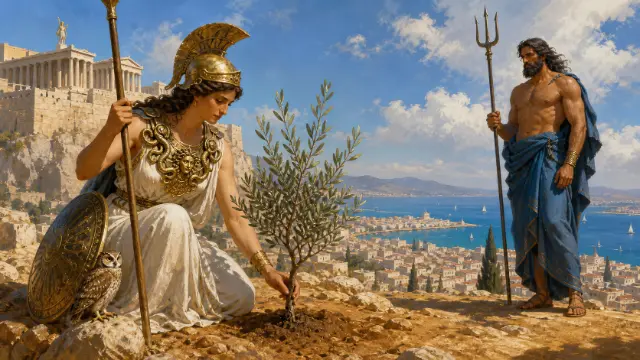 Read the myth: Athena and Poseidon →
Temples and representation
The Temple of Poseidon at Cape Sounion stands above a sea route near Athens, a setting that makes the god’s maritime role tangible. He appears in sculpture with a trident and often a beard and strong build. The famous Artemision Bronze in Athens has been identified as either Zeus or Poseidon because the object in its raised hand is missing; it should not be labelled confidently as one or the other.
The name in Greek
Modern Greek writes his name Ποσειδώνας. Ancient texts more often have Ποσειδῶν, a form that makes the language shift visible. The planet Neptune uses the Roman equivalent, while Greek place names and sanctuary remains continue to anchor Poseidon in an Aegean landscape.
Famous places and depictions
Sanctuaries and works of art where this god was honoured or depicted. Lost statues and uncertain identifications are identified as such.
- Temple of Poseidon at SounionAttica, Greece
The surviving temple overlooks the Aegean.
- ErechtheionAthens, Greece
Ancient accounts connect this Acropolis sanctuary with Poseidon’s contest with Athena.
Ancient sources and further reading
Homer, Odyssey 1 and 9–13; Homer, Iliad 15; Pausanias, Description of Greece 1.26.
For the wider context of Greek worship and art, see the Metropolitan Museum of Art.