

Hephaestus
Ήφαιστος
Fire, metalworking and invention
Hephaestus is the divine smith who makes objects that other gods and heroes depend on. His workshop connects fire to skilled labour rather than destruction alone. Myths also describe a physical disability and his exclusion from Olympus; their details vary, and the god’s craft should never be treated as a “cure” that erases it.
A contested beginning
Hesiod says Hera bore Hephaestus without Zeus. Homer’s poems offer different details about his fall from Olympus and his place among the gods. The variants reveal the flexibility of myth, while the shared thread is a gifted maker whose work carries power. The Iliad lets him speak, welcome guests and move through his workshop, rather than leaving him as a silent symbol.
Objects that change stories
In the Iliad, Hephaestus makes Achilles a new shield with scenes of cities, farming, dancing and war. He creates thrones, armour and other remarkable works across Greek tradition. The Odyssey tells how he traps Ares and Aphrodite in a finely made net. His craft can be generous, protective or ingenious in revenge.
 Read the myth: Hephaestus →
Cult and representation
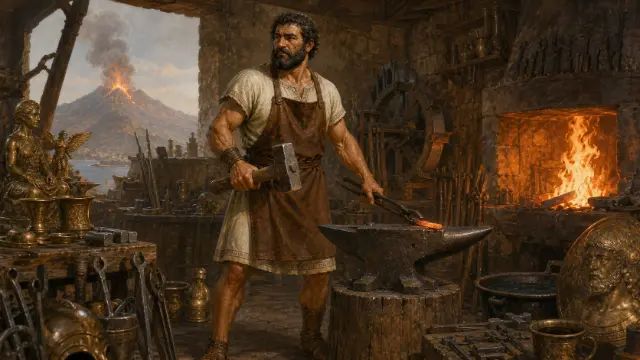
Athens honoured Hephaestus alongside Athena as a divine patron of making. The well-preserved Temple of Hephaestus overlooks the ancient Agora. Artists often show him with hammer, tongs or a craftsman’s cap. Such tools make him identifiable even where a surviving statue is fragmentary.
A modern connection
The Greek name Ήφαιστος survives in Modern Greek, and the word ηφαίστειο means volcano. That word evokes fire, though Hephaestus’s mythic forge is also about practical skill and making things well. His page links mythology to work, craft and the material culture of ancient cities.
Famous places and depictions
Sanctuaries and works of art where this god was honoured or depicted. Lost statues and uncertain identifications are identified as such.
- Temple of HephaestusAthens, Greece
One of the best-preserved ancient Greek temples.
- Ancient AgoraAthens, Greece
The crafts and civic life of the district give context to his cult.
Ancient sources and further reading
Homer, Iliad 18.369–617; Homer, Odyssey 8.266–366; Hesiod, Theogony 927–929.
For the wider context of Greek worship and art, see the Metropolitan Museum of Art.