

Ares
Άρης
War and the violence of battle
Ares embodies the force and disorder of battle. He is often contrasted with Athena’s strategic defence, yet Greeks did worship him and did not treat him merely as a villain. Homer gives him a vivid, sometimes humiliating role on the battlefield, while later art developed the armoured warrior image by which he is known.
Ares in epic
In the Iliad, Ares intervenes in the Trojan War and is wounded by Diomedes with Athena’s help. Zeus rebukes him, and the scene shows how dangerous even a god of war can become when passions govern a fight. Homer’s depiction is a literary characterisation; it does not cancel the god’s place in ritual or local cult.
Stories and family
Hesiod names Ares as a child of Zeus and Hera. Ares and Aphrodite appear together in the song of Demodocus in the Odyssey, where Hephaestus exposes their affair. The story is comic and sharp at once, revealing a divine family that is not a model of perfect conduct. Other traditions give Ares children linked to conflict, courage or fear.
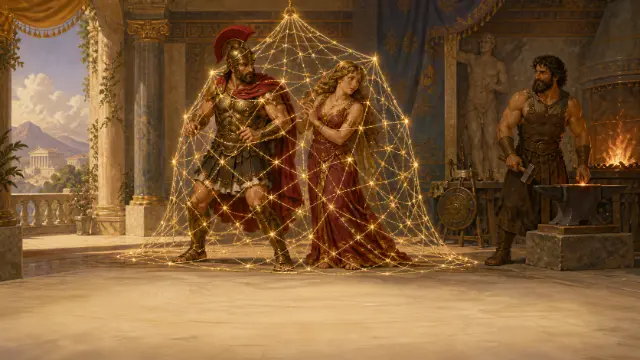 Read the myth: Ares and Aphrodite →
Worship and visual identity
Ares had sanctuaries and altars, although he was not the patron of a single Panhellenic centre like Zeus at Olympia. Athens linked his name to the Areopagus, the “Hill of Ares”, where a council met. Roman marble copies of Greek types show him with helmet and shield; the Ares Ludovisi is among the best-known examples.
A name with a different life
Άρης remains a Greek personal name and the Greek name of the planet Mars. The Roman Mars became central to Rome’s state identity in ways that do not map perfectly onto Greek Ares. Comparing the two gods is more useful than treating their names as interchangeable labels.
Famous places and depictions
Sanctuaries and works of art where this god was honoured or depicted. Lost statues and uncertain identifications are identified as such.
- Ares LudovisiPalazzo Altemps, Rome, Italy
A famous Roman marble representation of the resting war god.
- AreopagusAthens, Greece
The “Hill of Ares” keeps the god’s name in the city landscape.
Ancient sources and further reading
Homer, Iliad 5; Homer, Odyssey 8.266–366; Hesiod, Theogony 921–923.
For the wider context of Greek worship and art, see the Metropolitan Museum of Art.