

Eros
Έρως / Έρωτας
Desire and attraction
Eros is both a force and a figure. Hesiod places Desire near the beginning of the cosmos, while later poets and artists show a winged youth or child beside Aphrodite. Those different images are not a contradiction to erase; they reveal how Greek ideas of desire changed across genres and centuries.
Before the Olympians
The Theogony names Eros among the earliest beings, before the familiar divine family has formed. In that setting he is a power that helps generation become possible. Later genealogies attach him to Aphrodite, and visual art gives him wings and a bow. A single family tree cannot represent all these traditions fairly.
Desire in stories
Eros’s arrows can unsettle gods and mortals, turning a feeling into the engine of a myth. The story of Eros and Psyche is best known from the Roman writer Apuleius, much later than early Greek epic. It should be labelled as a later ancient tale rather than presented as a Homeric myth. Greek vase paintings and Hellenistic poetry offer other, sometimes playful, images of him.
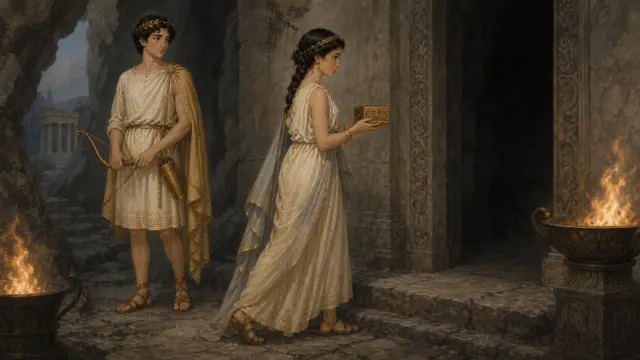 Read the myth: Eros and Psyche →
Sculpture and afterlife
The winged Eros was a favourite subject for Greek and Roman sculptors. Canova’s Psyche Revived by Cupid’s Kiss in the Louvre shows how a later artist transformed the ancient story. Its figures are not the same thing as a classical cult image, but they show how widely the god’s image travelled.
A word still alive
Modern Greek έρωτας means romantic love, and Έρως is the classical literary form. The word erotic comes from the same root. This direct linguistic survival is more revealing than the simplified Valentine’s Day Cupid, whose appearance and setting come mainly from much later European art.
Famous places and depictions
Sanctuaries and works of art where this god was honoured or depicted. Lost statues and uncertain identifications are identified as such.
- Psyche Revived by Cupid’s KissLouvre Museum, Paris, France
Canova’s sculpture depicts the later story of Eros and Psyche.
- Greek and Roman Eros figuresMetropolitan Museum of Art, New York, USA
The collection holds many ancient winged Eros representations.
Ancient sources and further reading
Hesiod, Theogony 116–122; Plato, Symposium; Apuleius, Metamorphoses 4–6 (later Roman tale).
For the wider context of Greek worship and art, see the Metropolitan Museum of Art.