

Hermes
Ερμής
Travel, messages, trade and boundaries
Hermes crosses boundaries. He carries messages between gods and mortals, guides travellers, and in some accounts leads souls toward the underworld. His speed and wit give him a playful reputation, but the boundary stones called herms show that his presence was part of everyday roads and public spaces.
The clever newborn
The Homeric Hymn to Hermes begins with the infant god stealing Apollo’s cattle. Hermes invents the lyre, negotiates with his older brother and wins a place among the Olympians. The story makes deception, invention and exchange part of his character. It also explains why a god of messages could be patron of trade and clever speech.
Guide between worlds
Hermes acts as a messenger in the Iliad and Odyssey. He helps Priam reach Achilles and gives Odysseus a protective plant before the hero meets Circe. As psychopompos, or conductor of souls, he travels where living people cannot. These roles connect roads, hospitality and the dangerous passage from life to death.
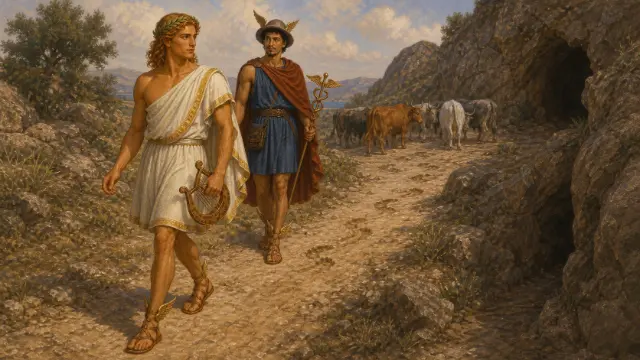 Read the myth: Hermes the cattle thief →
Where his image appears
Herms—square pillars with the god’s head—marked roads, thresholds and public areas. The marble Hermes carrying the infant Dionysus at Olympia is among the most famous statues associated with him; its attribution to Praxiteles remains debated. His staff, hat and winged footwear became lasting visual shortcuts in later art.
Language and legacy
The modern Greek name Ερμής is also the name of the planet Mercury. Words for interpretation, including hermeneutics, have long been linked to his name. Learning the Greek behind the familiar Roman “Mercury” restores the god’s place in Greek travel and storytelling.
Famous places and depictions
Sanctuaries and works of art where this god was honoured or depicted. Lost statues and uncertain identifications are identified as such.
- Hermes and the infant DionysusArchaeological Museum of Olympia, Greece
A celebrated marble statue traditionally linked with Praxiteles.
- Ancient AgoraAthens, Greece
Hermaic pillars once marked civic routes and entrances.
Ancient sources and further reading
Homeric Hymn to Hermes; Homer, Iliad 24; Homer, Odyssey 10 and 24.
For the wider context of Greek worship and art, see the Metropolitan Museum of Art.