

Zeus
Δίας / Ζεύς
Sky, kingship and oaths
Zeus is the ruler of the Olympian gods, but Greek worshippers knew him through more than lightning. They invoked him as a guardian of guests, oaths and justice, and gave him different local titles at different sanctuaries. His authority did not make him the creator of the world or remove the limits set by fate in every story.
How Zeus became king
Hesiod tells how Rhea saved the infant Zeus from Cronus, who had swallowed his other children. Zeus later forced Cronus to release them and led the younger gods against the Titans. This is a story of succession, not a single account accepted unchanged by every ancient Greek. In Homer, Zeus presides over a divine family whose members argue, resist and sometimes evade him.
Power and character in myth
The Iliad shows Zeus weighing the fortunes of warriors and trying to balance his affection for mortals with the larger course of the war. Other myths tell of his many unions and transformations, often with consequences for women and children that modern readers should not romanticise. Zeus Xenios protected hospitality; Zeus Horkios witnessed oaths. Both names mattered in ordinary dealings, far beyond epic battles.
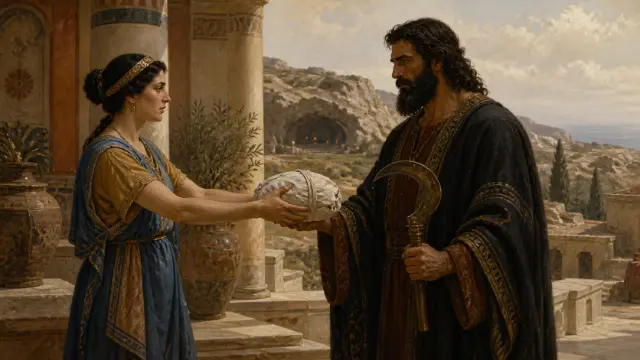 Read the myth: Cronus and Zeus →
Worship and images
Olympia was a major sanctuary of Zeus. Its games formed part of a religious festival, and the colossal gold and ivory cult image made by Phidias became one of the Seven Wonders of the ancient world. The statue is lost; temple remains and later descriptions allow us to study it indirectly. In art, a mature bearded man with thunderbolt or eagle is a common way to identify him.
A name that remains
Modern Greek uses Δίας for both the god and the planet Jupiter. The older form Ζεύς survives in ancient texts, while words such as Διός in names and expressions recall a different case of the same ancient name. Reading both forms helps connect the language of mythology to the Greek spoken today.
Famous places and depictions
Sanctuaries and works of art where this god was honoured or depicted. Lost statues and uncertain identifications are identified as such.
- Temple of Zeus at OlympiaOlympia, Greece
Site of the lost seated cult statue by Phidias.
- Pergamon AltarBerlin, Germany
Its Gigantomachy frieze depicts Zeus in battle.
Ancient sources and further reading
Hesiod, Theogony 453–506; Homer, Iliad 1 and 8; Pausanias, Description of Greece 5.11.
For the wider context of Greek worship and art, see the Metropolitan Museum of Art.